New hires can take up to eight months to reach full productivity, and that gap costs more than a slow start suggests (Source: SHRM). Most L&D teams still treat onboarding as a checklist: paperwork, system access, a welcome deck. What gets missed is the point where ramp time turns into a retention problem. A well-built corporate LMS closes that gap by giving new hires a structured path instead of a scattered one. This article explores why onboarding speed now functions as a retention metric, supported by data-driven insights.
Time-to-productivity is the number of days a new hire needs to perform their role independently, at the standard expected of the position. Every extra week of ramp time means lower output, more manager coaching hours, and a wider window for early attrition. Replacing a mid-level employee and absorbing that ramp-up delay costs over $30,000 once lost output and rehiring are factored in (Source: Oxford Economics). Slow onboarding is not a soft-skills problem, it is a line item. A corporate LMS is what turns that line item into something a team can manage. Without one, most teams only notice the cost after a new hire has already quit.
Unstructured onboarding does not just delay productivity, it accelerates exits. One in five employees who leave within their first year do so inside the first 45 days. That is often before a manager notices something is wrong (Source: Enboarder). Only 29% of new hires feel fully supported and prepared once formal onboarding ends (Source: Gallup). A scattered mix of PDFs, Slack messages, and shadowing sessions cannot close that gap consistently. It works for employees who land a good manager. Everyone else is left to figure it out, and some leave before they do.
A dip in new-hire performance during the first quarter usually reads as a training problem. The response, then, is more content: another module, another deck, another day of orientation. The actual issue is rarely a lack of information. It is the absence of a consistent path telling every new hire what to learn and when. A corporate LMS is built to solve exactly that consistency problem. Teams without a corporate LMS in place are the ones most exposed to this kind of early attrition.
If retention and engagement are a priority for your team, book a demo and see how LearningOS delivers both.
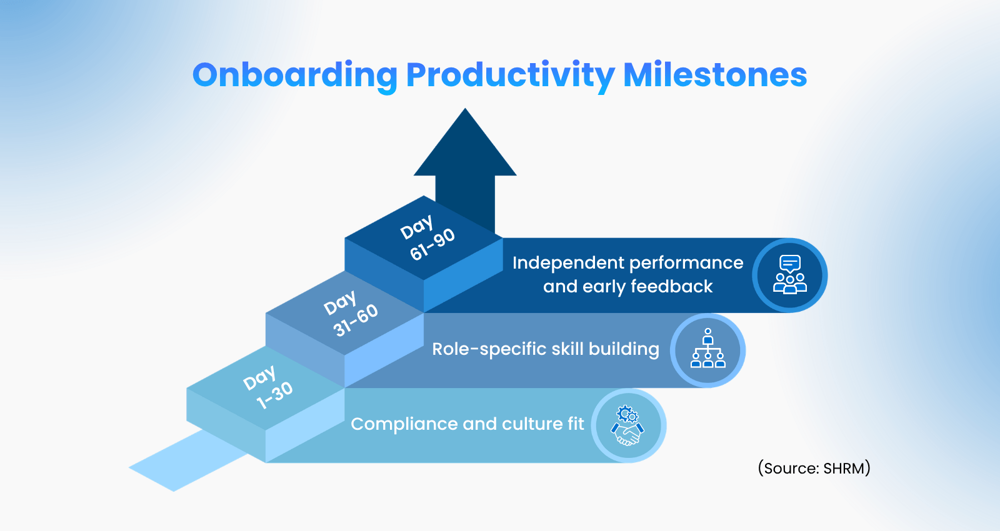
Most HR practitioners treat 90 days as the minimum structured onboarding window inside a corporate LMS. Full productivity, though, often lands somewhere between three and eight months depending on role complexity (Source: SHRM).
Days 1-30: Compliance and culture fit
Days 31-60: Role-specific skill building
Days 61-90: Independent performance and early feedback
A corporate LMS is what keeps this 30-60-90 structure consistent instead of depending on memory or good intentions. Stretching structured support beyond day 90, even lightly, correlates with stronger retention than treating onboarding as a first-week event.
A corporate LMS replaces the scattered mix of tools with a single, structured onboarding path. Instead of a generic PDF sent to every new hire, role-based tracks assign the right professional training courses at the right stage. Automated enrollment then moves someone from onboarding into ongoing development without a manual handoff. This is where a structured onboarding path does the heavy lifting that ad hoc coaching cannot. Consistent delivery across every new hire, regardless of which manager they land with, is the core promise of an LMS for corporate training done right.

Read more
>>> From Onboarding to Mastery: How a Capability LMS Supports Employee Growth
>>> Effective Onboarding Strategies for New Sales Hires: Setting Them Up for Success
>>> How to Foster a Continuous Learning Culture with an LMS
Completion rates tell you who finished a course, not whether they can do the job. A corporate LMS is what makes time-to-productivity, early skill quotient gains, and 90-day retention visible in the first place. Otherwise, that data stays scattered across spreadsheets nobody updates. Organizations with structured onboarding report 82% higher new-hire retention and productivity gains above 70% (Source: Brandon Hall Group). LearningOS clients report 30 to 50% higher employee retention once onboarding moves onto a single tracked corporate LMS platform. Retention like that is not an HR win, it is a budget one.
Start by pulling your current time-to-productivity by role, then compare it against the 90-day benchmark. Map every scattered onboarding step, that welcome deck, that shadowing week, that Slack channel, onto a single structured path inside your corporate LMS. Track it the same way you track pipeline or revenue: as a number that moves, gets reviewed, and gets fixed when it slips.
Picture a new hire on a fixed, role-based track inside a corporate LMS from week one, instead of a stack of unrelated links. They complete compliance and culture modules by day 30. By day 60 they move into role-specific training, and by day 90 they reach a manager-reviewed checkpoint, all logged automatically. Once ramp time is visible, it stops being an HR footnote and becomes a retention lever leadership actually watches.
Onboarding speed was never just an HR checklist item. It is one of the clearest early signals of whether a new hire will still be there in a year. A corporate LMS will not fix a broken hiring process, but it will stop your ramp time from quietly becoming your retention problem. Audit where new hires stall, put a structured path in place, and start treating time-to-productivity as a metric worth reporting on.
Poor onboarding is one of the fastest ways to lose new talent. Book a free call and learn how LearningOS helps your team ramp up faster.
At OOOLAB (pronounced "uːlæb"), our mission is to make complex learning operations simple. We aim to positively impact the lives of over 1,000,000 learners and educators by the end of 2026. OOOLAB's LearningOS provides educational institutions and corporate enterprises with an all-in-one solution to create and deliver engaging learning experiences.
Dedicated success manager
Personalized setup
Ongoing assistance
Learn more at thelearningos.com
1. How long should employee onboarding take?
Most HR practitioners treat 90 days as the minimum for structured onboarding. That covers compliance and culture in the first 30 days, role-specific skills in days 31 to 60, and independent performance in days 61 to 90. Full productivity, however, often takes three to eight months depending on role complexity. Stretching structured support beyond the first 90 days, even lightly, tends to improve retention outcomes.
2. What is time-to-productivity and why does it matter for retention?
Time-to-productivity is the number of days a new hire needs to perform independently at the standard expected of their role. It matters for retention because slow ramp-up periods are strongly linked to early attrition. Replacing a mid-level employee plus their lost output can cost more than $30,000.
3. How does a corporate LMS speed up onboarding?
A corporate LMS replaces scattered onboarding materials with a single structured path. It assigns role-based training and automatically enrolls new hires into the right professional training courses at the right stage. This removes the inconsistency that comes from relying on individual managers to onboard well.
4. Why do new hires leave in their first 90 days?
New hires often leave early because onboarding stops at orientation instead of extending through the ramp-up period. One in five early departures happen within the first 45 days. Fewer than a third of new hires feel fully supported and prepared once formal onboarding ends.
5. How do you measure onboarding ROI?
Track time-to-productivity, 90-day retention, and skill quotient gains rather than course completion rates alone. Structured onboarding correlates with 82% higher retention and 70%+ higher productivity. LearningOS clients report 30 to 50% higher employee retention after standardizing onboarding on one platform.