By 2030, 39% of core workforce skills will have changed (WEF Future of Jobs Report, 2025), and distributed, hybrid sales teams are now the dominant structure across global enterprises. Most training infrastructure wasn't built for this pressure. Effective sales training for distributed teams isn't a scheduling problem; it's an architecture problem.
The short answer: Effective distributed sales team training combines three layers: structured content via an Enterprise LMS, live virtual facilitation for collaborative skill-building, and AI-powered roleplay for on-demand practice. Running all three from a single learner record keeps coaching quality consistent regardless of region or time zone.
62% of sales leaders cite outdated training as their biggest performance barrier (The Sales Collective, 2025). Without ambient coaching or in-person ride-alongs, managers default to pipeline reviews rather than skill-building sessions, so training reflects local priorities rather than a central standard.
The further a sales training programme spreads geographically, the wider regional standards diverge: a new hire in London onboards differently than a rep in Singapore. Left unmanaged, that variation erodes performance in ways a central view can't diagnose.
The async layer is the foundation: a structured Enterprise LMS delivers product knowledge, compliance content, and process documentation on demand, so every rep starts from the same baseline. Companies with formal sales training programmes achieve 78% quota attainment, versus 63% without (RAIN Group). The difference is consistency, not content volume.
Structured async content handles what; live virtual sessions handle how. Facilitated sessions on deal strategy, objection handling, and regional case studies give distributed teams a collaborative space self-paced content can't replicate, and give managers visibility into skill gaps before quarter-end.
The third layer connects learning to the moment it matters most: before a call, during a launch, or right after a lost deal. Microlearning nudges embedded in CRM workflows reinforce async content without pulling reps out of their day.
Read more
>>> What Is Hybrid-Blended Learning and Why Is It Gaining Popularity?
>>>The Future of Corporate Training: Hybrid Learning Approaches
Ready to see AI roleplay and assessment in action? Book a free demo and watch your team's training performance shift.
Without reinforcement, reps forget up to 87% of training content within a month, a pattern long documented by the Ebbinghaus Forgetting Curve. Real-world scenarios improve retention by 70% over lecture-based methods (Sales Performance International). 43% of revenue enablement leaders now use AI-powered coaching for distributed teams (Allego, 2025), and AI-assisted coaching lifts sales performance by 25% (Deloitte, 2025).
Every rep should practise the same pitch to the same standard, regardless of location. AI Sales Roleplay makes that standardized and feedback-rich without a trainer in each region. Skill Quotient OS is LearningOS's native AI roleplay and competency assessment tool, and enterprise B2B teams using AI in coaching are 20% more likely to improve revenue outcomes (Highspot, 2025).
Read more
>>> Sales Training and Enablement Strategies for Enterprise Teams
Mapped to LearningOS's architecture, the three layers become system components:
Enterprise LMS - async delivery, compliance tracking, and certification; the system of record for what's been taught across every region.
Virtual Learning Environment - facilitated, scheduled sessions where distributed teams meet in real time, across time zones.
AI Powered LMS / Skill Quotient OS - on-demand roleplay and competency-based progression, so reps get consistent feedback without waiting on a manager.
LearningOS combines all three layers natively, with Skill Quotient OS embedded as the AI practice layer. Clients report $3.5 ROI on every dollar invested and 40-60% less training time, the result of one thing: a single learner record spanning all three layers, with one admin interface and one unbroken view of every rep's development.
Running two or three disconnected platforms doesn't double your training capability. It halves your visibility into what your sales force actually knows.
Read more
>>> Enterprise LMS and the Hybrid Workforce: Training for the Future
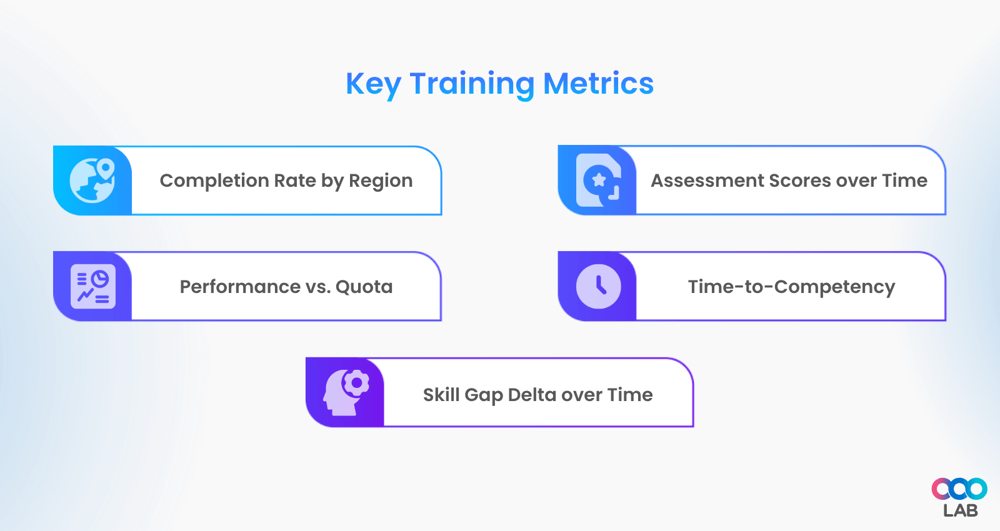
52% of sales teams lack the analytics to measure training ROI (Global Growth Insights, 2026). Measuring competency and skill development across regions takes more than completion rates. Five indicators tell the fuller story:
Completion rates by region: gaps here reveal structural access or engagement issues
Assessment scores over time: measures whether learning is transferring, not just occurring
AI roleplay performance vs. quota attainment: connects practice quality to deal outcomes
Time to competency for new hires: the clearest signal of onboarding programme effectiveness
Skill gap delta over time: shows whether the training stack is closing the gaps it was designed to close
Moving from "Did they complete it?" to "Did it change how they sell?" requires training and performance data to share the same system.
Distributed sales teams are now the permanent state of enterprise selling, and training infrastructure needs to match. The organisations closing the performance gap aren't adding more tools; they run structured delivery, live facilitation, and AI-powered practice from one unified system, measured against real business outcomes.
Built for L&D leaders who need results, not more admin. Book your free demo and bring your learning operations up to speed.
At OOOLAB (pronounced "uːlæb"), our mission is to make complex learning operations simple. We aim to positively impact the lives of over 1,000,000 learners and educators by the end of 2026. OOOLAB's LearningOS provides educational institutions and corporate enterprises with an all-in-one solution to create and deliver engaging learning experiences.
Dedicated success manager
Personalized setup
Ongoing assistance
Learn more at thelearningos.com
1. What is the best way to train a distributed sales team?
The most effective approach combines three layers: async content via an Enterprise LMS, live virtual facilitation, and AI-powered roleplay. Running all three from a single learner record ensures coaching consistency across regions. Companies with formal sales training programmes achieve 78% quota attainment, compared to 63% without.
2. How does blended learning work for remote sales reps?
For remote sales teams, blended learning means three things: self-paced LMS modules, live virtual sessions, and microlearning nudges in CRM workflows. The async layer builds knowledge, the live layer builds judgment, and the in-flow layer reinforces both at the moment reps need it most.
3. What is AI sales roleplay and how does it improve training outcomes?
AI Sales Roleplay uses AI to simulate realistic sales conversations, giving reps on-demand practice with standardized feedback at scale. Without reinforcement, reps forget up to 87% of training content within a month, per the Ebbinghaus Forgetting Curve. AI-assisted coaching lifts sales performance by 25%, providing consistent, scalable practice that manager-led coaching alone cannot deliver.
4. How do you track sales competency and skill development across distributed teams?
Effective tracking requires a unified learner record connecting training activity to business performance data. Key metrics include: completion rates by region, assessment scores over time, AI roleplay performance relative to quota attainment, time to competency for new hires, and skill gap reduction rates. Platforms that fragment this data across separate tools make it nearly impossible to connect training investment to revenue outcomes.
5. What features should an enterprise learning platform have for distributed sales teams?
A platform for distributed sales teams needs five capabilities from one learner record: structured course delivery and compliance tracking; AI-powered sales roleplay and competency assessment; a unified learner profile; analytics connecting training to business outcomes beyond completion rates; and mobile-first access across iOS, Android, and desktop. LearningOS delivers all five natively, combining an Enterprise LMS, Virtual Learning Environment, and Skill Quotient OS.