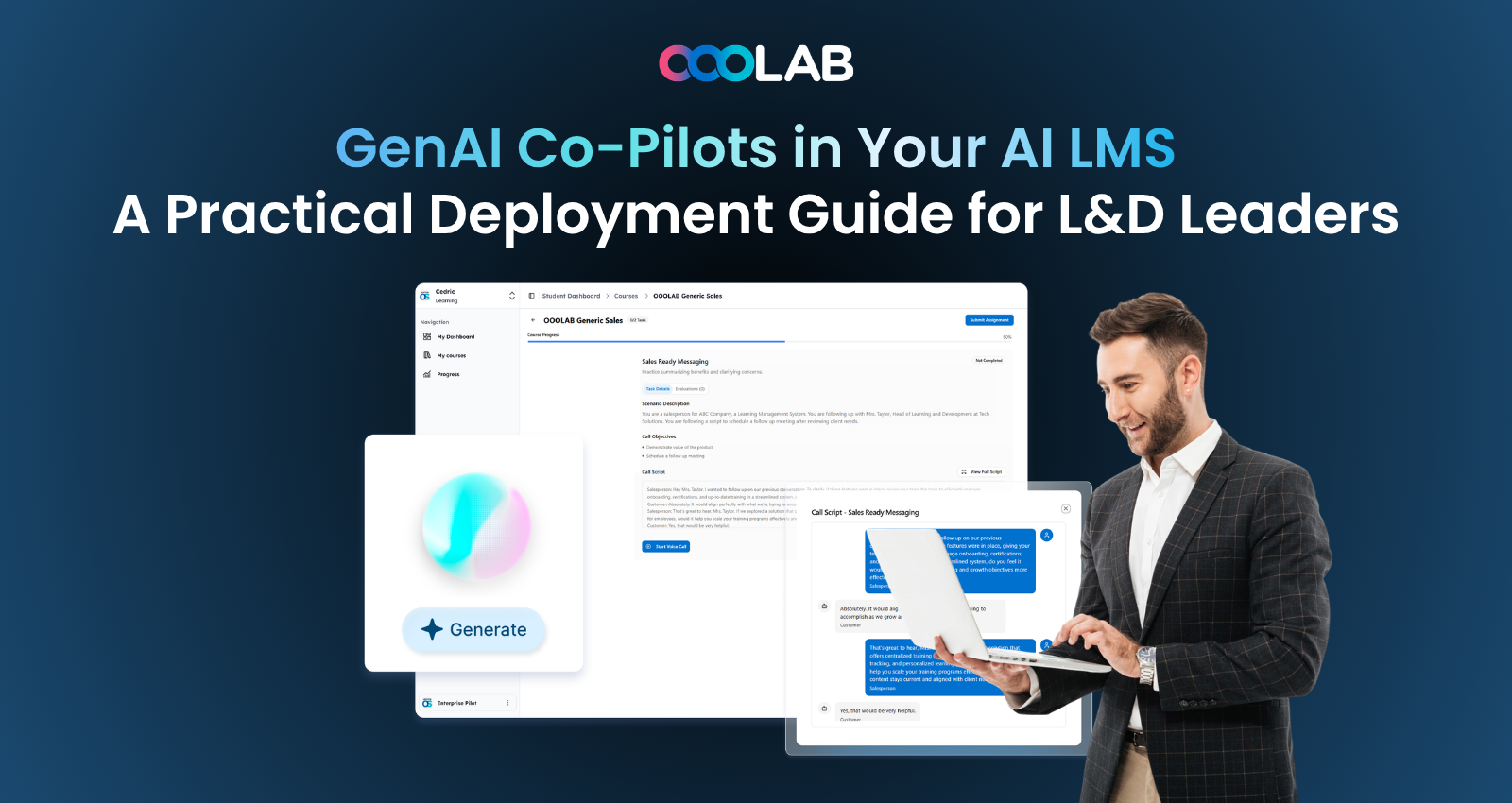
A BCG Henderson Institute experiment, reported in Harvard Business Review (Sept 2025), showed that GenAI-powered tutoring can deliver personalized, engaging training at scale, a result simply not achievable with traditional LMS content delivery. At the same time, 87% of L&D teams already use AI in some form.
The problem is no longer awareness. Most L&D leaders can list AI features. Few have a deployment plan that turns those features into measurable outcomes. This guide explores GenAI co-pilots in corporate training: what they are, how they work, and how to deploy them with confidence.
A GenAI co-pilot is an AI layer inside your enterprise LMS that generates, personalises, and iterates on training content in real time, working alongside your L&D team rather than replacing it. Two capabilities are often conflated under the "AI" label, and the distinction matters.
GenAI features handle content generation: auto-drafting modules, writing assessments, and translating content. Adaptive AI features adjust the experience based on what a learner actually does, including sequencing content, scaling difficulty, and identifying skill gaps. A well-architected AI LMS combines both. Conflating them leads to misaligned expectations and underused platforms.
By 2026, over 60% of enterprise applications are expected to embed GenAI to augment workflows. (Source: Gartner, Oct 2025) The organisations that get ahead understand what each capability is doing inside their platform, not just that it exists.
These four capabilities are where AI-powered LMS platforms deliver measurable business value, each mapping to a specific L&D problem worth solving.
GenAI compresses the content assembly cycle dramatically. Point the co-pilot at a compliance document, sales playbook, or product brief and it produces a structured course framework: objectives, module outlines, knowledge checks, and a summary assessment. Instructional designers review and approve. They stop being content factories and start being quality directors.
Personalised learning boosts engagement by 67% and retention by 56% compared to standard programmes. (Source: McKinsey, 2024) Adaptive AI inside your capability LMS makes this achievable at scale, using role, performance history, and behavioural signals to surface the right content at the right moment.

Multiple-choice quizzes measure recall. They do not measure whether a learner can handle a difficult customer or close a complex deal under pressure. GenAI creates realistic, branching AI sales roleplay scripts for the situations learners will actually face. Skill Quotient OS, OOOLAB's AI roleplay and assessment tool, generates, delivers, and scores these interactions at enterprise scale.
The platform surfaces skill gaps as they emerge, flags learners at risk of falling behind, and suggests content adjustments before a problem becomes a retention issue. Managers get dashboards showing competency and skill progression, not just module completion rates.
Bring your Training and Learning to a new height. Book a Free Demo with LearningOS.
Most GenAI deployments stall not because the technology fails, but because the rollout lacks structure. This three-step framework gives your team a clear path from pilot to programme - with the evidence to scale.
Audit and align. Identify the 2–3 use cases where GenAI will have the fastest measurable business impact. Onboarding, compliance refreshers, and sales enablement are the most common starting points because they have clear timelines, defined audiences, and existing content to build from. Map each use case to a specific competency and skill gap in your current training programme before selecting features or platforms.
Pilot and measure. Launch a single-team pilot with a defined success baseline. Before the pilot begins, agree on the metrics that will determine whether you expand: time-to-competency, assessment score improvement, course completion rate, and manager satisfaction scores all work well. The data you collect in a 60-day pilot is more persuasive to a CFO than any vendor case study.
Scale and iterate. Use pilot results to build the business case for organisation-wide rollout. Your learning & development LMS should feed real-time analytics back into every iteration - not just confirm that learners completed modules. LearningOS clients report 40–60% less training time and $3.50 ROI on every dollar invested. (Source: LearningOS client outcomes) Those are the numbers that make the scale conversation straightforward.
Read more
>>> How AI is Revolutionizing Learning Management Systems (LMS)
>>> How an AI-Powered LMS Enhances Employee Training and Performance
>>> Measuring Training Effectiveness with an L&D LMS
>>> How Enterprise LMS Platforms Leverage AI for Personalized Learning
GenAI output requires human review, always. Your governance framework should cover 4 areas before going live:
Content accuracy checks where SME review and sign-off for every AI-generated module
Bias audits for scenario-based content
Data privacy confirmation in which your LMS vendor proves they hold valid SOC 2 Type 2 and ISO 27001 certifications
Human-in-the-loop approval workflows that treat AI-authored content with the same rigour as human-authored content

Gartner predicts that through 2026, 50% of global organisations will require "AI-free" assessments to guard against critical-thinking atrophy. (Source: Gartner, Oct 2025) That is an argument for intentional design. Your governance framework should specify which assessments remain unassisted and why.
Read more
>>> We've Been Recertified for SOC 2 Type 2 and ISO/IEC 27001:2022
>>> Data Security and Privacy in Enterprise LMS
The anxiety is real: 43% of L&D leaders worry AI could entirely replace their roles. (Source: LearnUpon State of L&D Report, 2025) The evidence points the other way. 72% of L&D professionals say the function will thrive by adapting, and 58% report that AI gives L&D more strategic influence inside their organisations. (Source: Synthesia AI in L&D Report, 2026)
The shift is a shift in role, not a replacement. AI automates the tactical layer: drafting content, building quiz banks, scheduling nudges. L&D professionals move up to what AI cannot reach: learning architecture, stakeholder alignment, outcome validation, and ethical oversight. A strong professional development LMS gives those professionals the infrastructure to do exactly that.
GenAI co-pilots have moved from feature announcements to operational infrastructure. The organisations closing skill gaps fastest in 2026 are the ones that deployed thoughtfully, with clear use cases, structured governance, and a human team that knows how to get the best from the technology.
Your AI LMS is only as effective as the strategy behind it. Start with one high-impact use case, measure it rigorously, and build from there.
Not sure where to start? Book a free session with our team and we'll map out a solution built around your training goals.
At OOOLAB (pronounced "uːlæb"), our mission is to make complex learning operations simple. We aim to positively impact the lives of over 1,000,000 learners and educators by the end of 2026. OOOLAB's LearningOS provides educational institutions and corporate enterprises with an all-in-one solution to create and deliver engaging learning experiences.
Dedicated success manager
Personalized setup
Ongoing assistance
Learn more at thelearningos.com
1. What is a GenAI co-pilot in an LMS?
A GenAI co-pilot is an AI layer built into a learning management system that generates training content, including courses, assessments, scenario scripts, and personalised feedback, on demand. It works alongside your L&D team by accelerating content creation and adapting learning experiences based on each learner's performance and role. Unlike a standard LMS feature set, a GenAI co-pilot actively assists the design process rather than simply delivering pre-built content.
2. How is GenAI different from adaptive AI in corporate training?
GenAI creates content: course modules, quiz questions, and feedback text from a prompt or source document. Adaptive AI responds to learner behaviour: it adjusts the sequence, difficulty, and pacing of a learning path based on real-time performance signals. A well-built AI LMS uses both. Knowing which is which helps L&D leaders evaluate platforms more accurately and set realistic learner outcomes.
3. What tasks can a GenAI co-pilot automate in my LMS?
A GenAI co-pilot can automate course structure generation from existing documents, assessment and quiz creation, scenario-based roleplay script development, content translation, and personalized feedback text. It can also analyse learner performance data to recommend content adjustments and flag skill gaps before they affect business outcomes. The highest-value automation targets are onboarding programmes, compliance refreshers, and sales enablement content.
4. How long does it take to see ROI from an AI-powered LMS?
LearningOS clients typically report positive ROI within 6–12 months of deployment, with a platform-wide average of $3.50 returned on every dollar invested. The fastest ROI tends to come from use cases with high content volume and frequent update cycles. Time-to-competency reductions of 40–60% are common once adaptive learning paths are fully configured.
5. How do I govern AI-generated content in my LMS?
Start with four baseline requirements: an SME review and sign-off process for every AI-generated module before publishing; a bias audit for scenario-based content; confirmation that your LMS vendor holds SOC 2 Type 2 and ISO 27001 certifications; and an approval workflow that treats AI-authored content with the same rigour as human-authored content. Beyond the basics, consider designating certain assessments as AI-free. Gartner projects that 50% of global organisations will require this by 2026 to protect critical-thinking skills.