For most of the last century, two metrics ruled talent decisions. IQ shaped hiring and academic selection for decades. EQ followed in the 1990s, shifting the conversation toward relational skills and leadership potential. Neither solved the problem L&D leaders still face today.
Around 85% of employers now use skills-based hiring (Source: TestGorilla, State of Skills-Based Hiring Report, 2024). Yet most have no consistent way to measure whether employees can actually perform the role once trained. They're spending on training, but not measuring whether that investment is building the capabilities the business requires.
That's the gap Skill Quotient (SQ) is designed to close: the third pillar of talent intelligence, sitting alongside IQ and EQ to answer the question both of them miss.
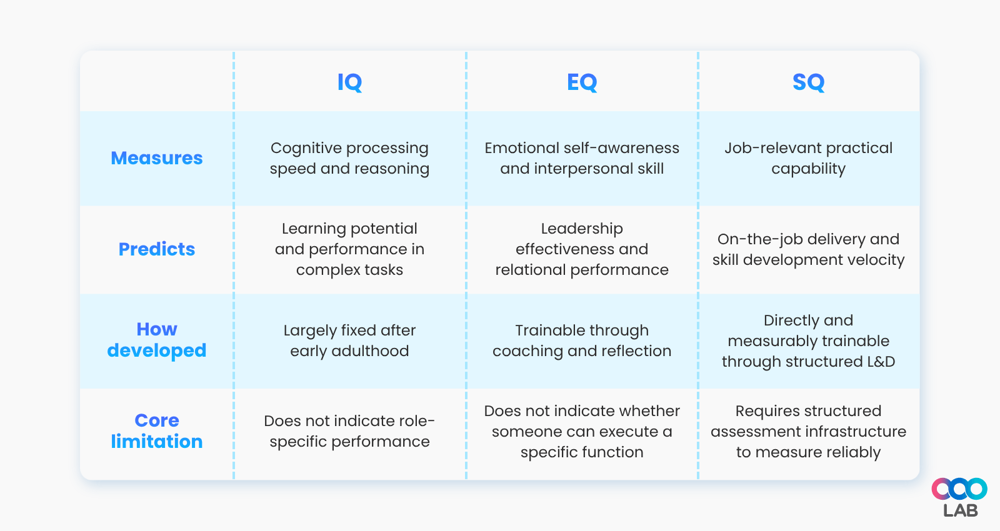
IQ measures cognitive processing speed, working memory, pattern recognition, and logical reasoning. Meta-analyses by Schmidt and Hunter found general mental ability is the single best predictor of job training success across occupations, with validity coefficients ranging from .30 for low-complexity roles to .70 or higher for complex professional jobs. That's a strong signal about learning potential. It is not a signal about applied performance.
IQ tells you how quickly someone absorbs new information. It does not tell you whether they'll close a deal under pressure or run an onboarding cohort without support. Once employees pass the cognitive threshold for a given role, IQ stops differentiating high performers from average ones.
As a development metric, IQ offers almost nothing. You can't train it up. Skill Quotient, unlike IQ, is fully buildable through structured learning.
Emotional intelligence entered business in 1995 through Daniel Goleman's landmark framework, defining five constructs: self-awareness, self-regulation, motivation, empathy, and social skill. For leadership development and customer-facing roles, EQ brought what IQ ignored entirely. Meta-analytic evidence shows the correlation between EQ and job performance is approximately .29, real but modest (Source: Journal of Organizational Behavior, 2010). In high-emotional-labour roles, EQ contributes. But it still doesn't answer whether someone can execute the function.
EQ tells you how a sales rep manages rejection. It does not tell you whether they can structure a discovery call or navigate a six-month enterprise procurement cycle. That predictive gap is exactly what Skill Quotient is built to address.
The cost of that gap is now visible at scale. According to the World Economic Forum's Future of Jobs Report 2025, 63% of employers identify skills gaps as their primary barrier to business transformation. Not a shortage of intelligence or emotional maturity. A shortage of practical, applicable capability.
Skill Quotient (SQ) is a measurable indicator of an individual's job-relevant capabilities: what they can currently do, how fast they build new skills, and how effectively they apply them under real conditions. SQ is a direct, trainable measure of whether your people can do what the role requires.
SQ operates across three dimensions: current capability (skills demonstrably held today, verified by assessment); development velocity (how fast new skills are acquired); and applied performance (how effectively skills translate under real conditions).
The WEF's Future of Jobs Report 2025 finds employers expect 39% of workers' core skills to change by 2030, while 50% of the workforce has completed training as part of L&D strategies, up from 41% in 2023. More training is happening. SQ answers whether it's converting into measurable capability.
Read more
>>> What Is Skill Quotient In HR
>>> Skill Quotient vs. IQ - Why Skills Matter More
>>> Redefining Talent Assessment with Skill Quotient
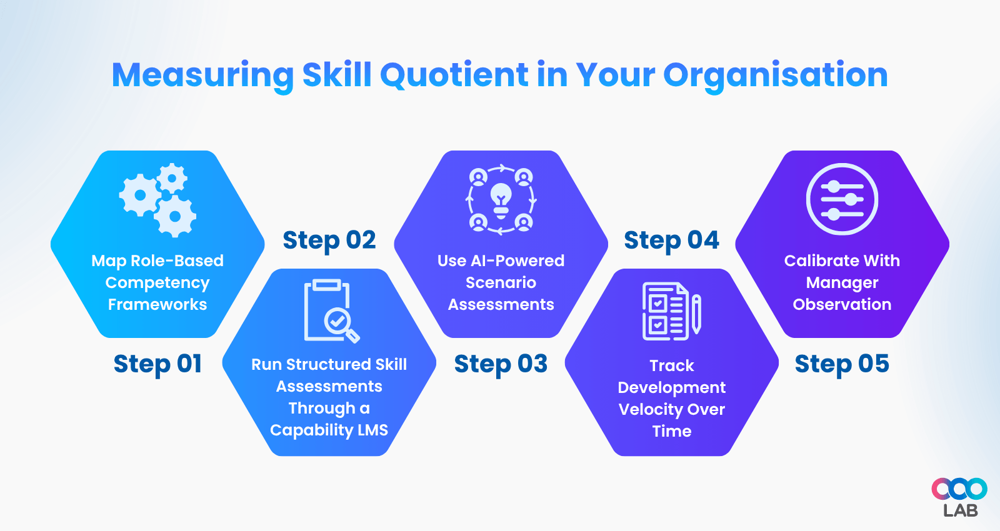
SQ is a composite picture built from multiple data points. Four steps get you there.
Step 1 - Map Role-Based Competency Frameworks
Define what skilled performance looks like at each stage for each role. Without this baseline, your assessments have nothing to measure against.
Step 2 - Run Structured Skill Assessments Through a Capability LMS
Establish pre-training baselines and track post-training scores over time. That delta is your first SQ data point.
Step 3 - Use AI-Powered Scenario Assessments
Static tests measure recall. Real SQ requires demonstration under pressure. OOOLAB's Skill Quotient OS delivers AI roleplay scenarios that generate structured evidence of applied capability, not just completion data.
Step 4 - Track Development Velocity Over Time
SQ is not a snapshot - it's a trajectory. A Professional Development LMS with built-in progress tracking converts assessment data into ongoing capability curves. It shows not just where someone is today but how fast they're developing. That velocity data enables your L&D team to identify which interventions are working and where investment needs to shift.
Step 5 - Calibrate With Manager Observation
Quantitative LMS data combined with structured manager input produces the most reliable SQ read. It closes the gap between what training records show and what the job actually demands.
Bring your Training and Learning to a new height. Book a Free Demo with LearningOS.
An enterprise LMS built for Skill Quotient tracking generates the capability data organisations need to make defensible decisions about development, promotion readiness, and skills gap closure. Four features work together: personalised learning pathways aligned to each employee's capability baseline; role-based assessment modules creating structured evidence at each development stage; manager calibration tools connecting platform data with real-world observation; and skills gap reporting surfacing the delta between current and required capability.
McKinsey research finds companies aligning L&D around skills see up to 40% greater productivity. Over 90% of employees say they're more likely to stay at a company that invests in their growth (Source: LinkedIn Workplace Learning Report, 2025). When training builds demonstrable capability tied to career progression, it becomes meaningful rather than obligatory.
LearningOS clients building SQ measurement into their programmes report 40-60% less training time, 30-50% higher employee retention, and $3.5 return on every dollar invested in L&D.
Read more
>>> Competency Mapping: Aligning Employee Skills with Organisational Goals
>>> Competency vs. Skill-Based Learning: How an LMS Can Help

IQ told organisations who could think. EQ told them who could connect. Skill Quotient tells them who can deliver, and whether training is building that capability over time.
The WEF confirms skills gaps are the single largest barrier to business transformation today. That makes SQ a present-tense operational priority. The organisations that close the gap will be those that move from measuring potential and personality to measuring practical capability, and build the infrastructure to develop it deliberately.
Not sure where your organisation sits on the SQ readiness curve? Book a free session with our team and we'll map out a solution built around your training goals.
At OOOLAB (pronounced "uːlæb"), our mission is to make complex learning operations simple. We aim to positively impact the lives of over 1,000,000 learners and educators by the end of 2026. OOOLAB's LearningOS provides educational institutions and corporate enterprises with an all-in-one solution to create and deliver engaging learning experiences.
Dedicated success manager
Personalized setup
Ongoing assistance
Learn more at thelearningos.com
1. What is Skill Quotient (SQ) and how is it different from IQ and EQ?
Skill Quotient (SQ) is a measurable indicator of an individual's job-relevant capabilities: what they can do in their role, how fast they build new skills, and how effectively they apply them under real conditions. IQ predicts learning potential; EQ predicts relational and leadership effectiveness. SQ is the only metric that directly assesses and tracks practical applied capability, and unlike IQ, it is fully trainable through structured L&D.
2. How do you measure Skill Quotient in the workplace?
SQ is measured through a combination of role-based competency frameworks, structured LMS assessments, AI-powered scenario evaluation, and manager observation. The process begins with a pre-training baseline assessment and tracks development velocity over time. Tools such as OOOLAB's Skill Quotient OS add an applied performance layer by generating structured evidence of how skills hold up under real working conditions.
3. What is the difference between IQ, EQ, and SQ at work?
IQ measures cognitive processing and reasoning; it is largely fixed after early adulthood and useful as a hiring filter. EQ measures emotional self-awareness and interpersonal skill; it is trainable through coaching and relevant for high-emotional-labour roles. SQ measures job-relevant practical capability; it is directly trainable through L&D and the most reliable predictor of whether an individual can perform a specific role under real conditions.
4. What is a Capability LMS and how does it support SQ development?
A Capability LMS is a learning management system designed to track, assess, and develop job-relevant skills against defined role competencies, not just log completions. It combines personalised learning pathways, role-based assessments, skills gap reporting, and manager calibration to generate structured SQ data over time. LearningOS operates as a full Capability LMS, combining content management, assessment, and real-time analytics in a single platform.
5. Why are skills gaps still growing if organisations are already investing in training?
Most organisations measure training activity, completions and hours logged, rather than training outcomes. Completing a course is not the same as building a skill. Without an SQ measurement framework, organisations cannot determine whether their L&D investment is converting into capability improvement. The WEF's Future of Jobs Report 2025 finds that even as 50% of the workforce has completed training, employers still expect 39% of core skills to change by 2030. More training without better measurement produces the same skills gap at greater cost.