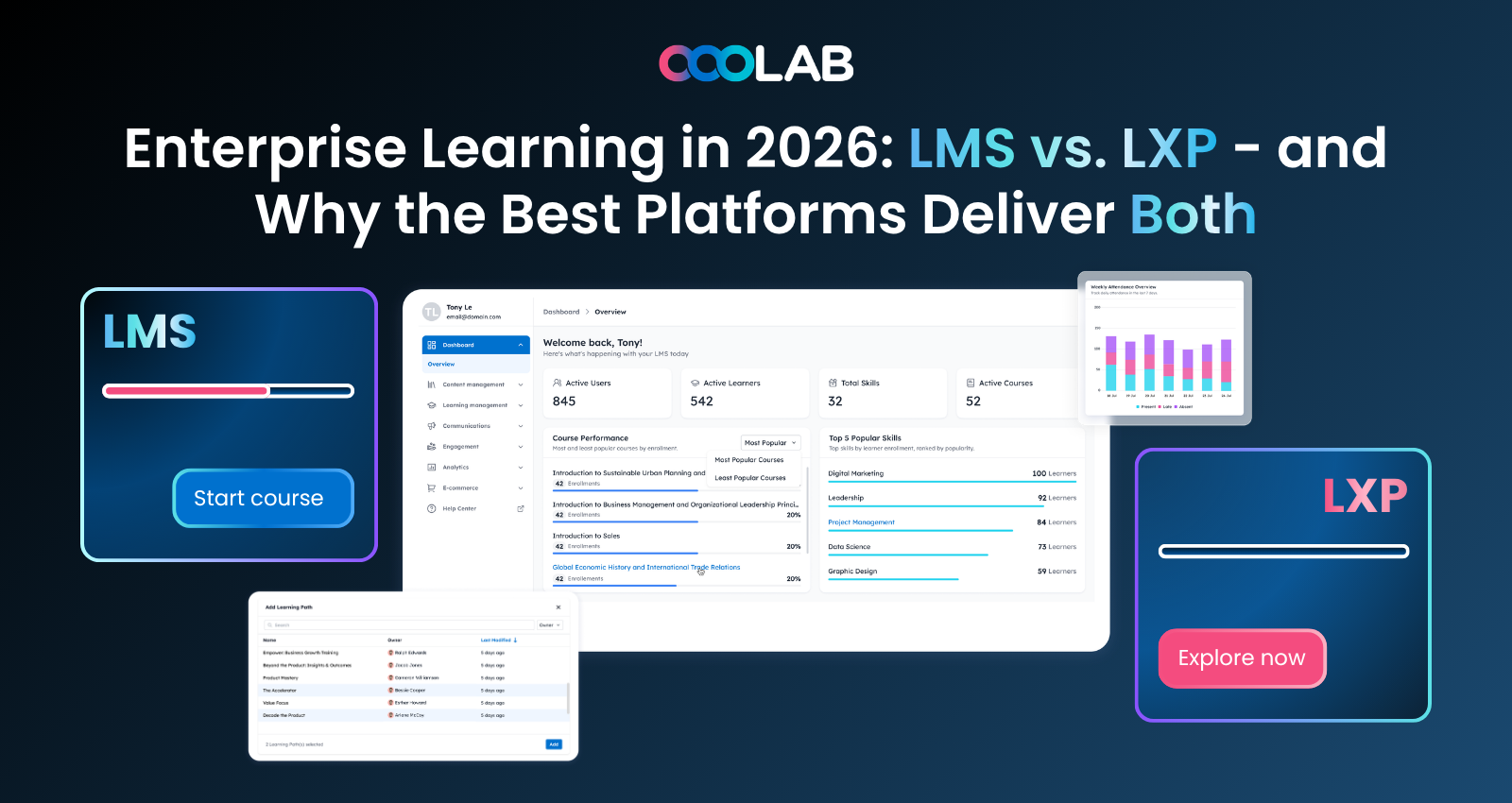
Only 16% of companies currently use an LXP - despite mounting evidence that a standard LMS alone no longer meets modern learner expectations. The technical skills half-life has dropped to just 2.5 years. L&D teams can't afford separate platforms to bridge that gap.
The conversation in 2026 isn't LMS or LXP. It's whether organisations still need to choose between them. This article explores the core differences, where each falls short, and what a genuinely unified solution looks like.
An Enterprise LXP - or Learning Experience Platform - is a learner-driven system that uses AI to surface personalised content and enable self-directed development. Unlike an LMS, it recommends training based on role, behaviour, and goals rather than assigning it. The LXP market reached $3.74 billion in 2025, growing at 33.79% compound annually (Source: Business Research Insights, 2026).
The core difference is control. An LMS is admin-led: it assigns, tracks, and reports on structured programmes. An LXP is learner-led: it recommends personalised content based on individual behaviour. An LMS handles what the organisation requires; an LXP supports what the learner chooses.
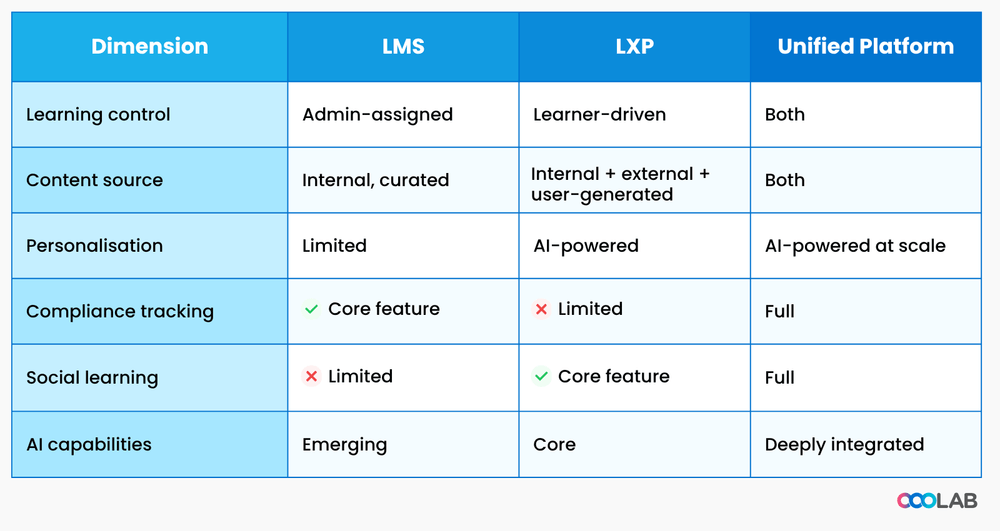
Neither is better. They serve different purposes. The problem starts when organisations need both and try to run them as separate systems.
74% of organisations say linking learning to performance is a top priority (Source: Docebo, 2026). Running a separate LMS and LXP works directly against that. When compliance tracking and personalised recommendations sit in different systems, learner data fragments, admins manage duplicate reports, and the connection between training and performance breaks down.
49% of L&D professionals report that their executives are concerned employees lack the skills to execute business strategy (Source: Docebo, 2026). A two-platform stack makes that gap slower to diagnose - not faster.
Read more
>>> The Future of Enterprise LMS: Trends Shaping 2026 and Beyond
>>> Enterprise LMS Features: What to Look For in 2026
Personalised learning boosts engagement by 67% and retention by 56% (Source: McKinsey, 2024). Delivering that at enterprise scale requires a structured delivery layer and an AI-powered discovery engine working from one learner record.

That's the architecture behind LearningOS: a single platform combining a CMS, LMS, Virtual Learning Environment, and Mobile Learner Portal - one dataset, one admin interface, one continuous learner journey. LearningOS clients report $3.5 ROI on every dollar invested, 40-60% less training time, and 30–50% higher employee retention.
Running two platforms doesn't double your capability. It halves your visibility into what your workforce actually knows.
Read more
>>> The Future of AI LMS: Personalized Learning at Scale
>>> From Data to Insights: How AI LMS Improves Learning Outcomes
A platform that genuinely replaces both needs five capabilities working from a single learner record: structured course delivery and compliance tracking; AI-powered personalised content recommendations based on role and skill gaps; a unified learner profile across all activity; analytics connecting learning to business outcomes - not just completion rates; and mobile-first access across iOS, Android, and desktop.
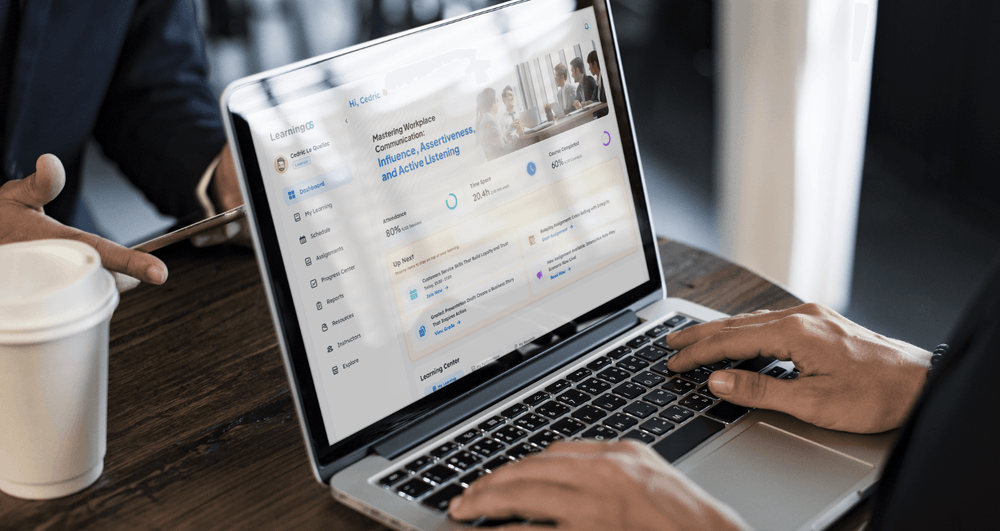
Bring your Training and Learning to a new height. Book a Free Demo with LearningOS.
Most enterprises need both - the question is whether to manage them separately or unify them. Four questions determine your architecture: Is your primary need compliance, upskilling, or both? Are employees engaging voluntarily beyond mandatory content? Do your platforms share a single learner record? Does your training data connect to business performance?
Compliance-only: your existing LMS may suffice. Upskilling-only: LXP capabilities are essential. Both present: a unified platform handling structured delivery and AI-powered personalisation from one learner record is the right answer for most enterprise organisations.
The LMS vs. LXP debate is dissolving. In 2026, what matters is one platform, one learner record, and analytics that connect training to real business outcomes. Organisations that resolve this through consolidation - not by adding a second platform - are seeing measurably better results.
Curious what an all-in-one LMS actually looks like in practice? Book a walkthrough - no commitment, just clarity.
At OOOLAB (pronounced "uːlæb"), our mission is to make complex learning operations simple. We aim to positively impact the lives of over 1,000,000 learners and educators by the end of 2026. OOOLAB's LearningOS provides educational institutions and corporate enterprises with an all-in-one solution to create and deliver engaging learning experiences.
Dedicated success manager
Personalized setup
Ongoing assistance
Learn more at thelearningos.com
1. What is the difference between an LMS and an LXP?
An LMS assigns and tracks structured training - compliance courses, onboarding, and certifications. An LXP uses AI to recommend personalized content based on learner behaviour and goals. Core difference: an LMS pushes learning onto employees; an LXP pulls them toward what's relevant.
2. Do I need both an LMS and an LXP for enterprise training?
Most enterprises need both capabilities - but not two separate platforms. Running them in parallel creates data silos and admin overhead that a single unified platform resolves from one learner record.
3. What is an Enterprise LXP and how does it work?
An Enterprise LXP recommends personalised training through AI, analysing each employee's role, behaviour, and skill gaps to surface relevant content - internal, external, or peer-generated - making it effective for continuous upskilling at scale.
4. What is Learning in the Flow of Work, and how does it relate to LMS and LXP?
Learning in the Flow of Work embeds skill-building directly into daily tasks. It requires compliance tracking and personalised recommendations to run from the same learner record - something separate platforms can't deliver cleanly.
5. What features should a unified enterprise learning platform include?
Compliance tracking and structured delivery, AI-powered content recommendations, a single unified learner record, analytics connecting training to business outcomes, and mobile-first access across iOS, Android, and desktop.