
Great salespeople are made, not born. The rep everyone calls a "natural" just put in more reps, got more feedback, and practiced more deliberately than anyone gave them credit for. That inconvenient truth clashes with how most companies still hire and train for sales training: chase the charismatic candidate, skip the structured coaching, and hope talent does the rest. It rarely does. This article explores why deliberate practice, not innate gift, builds elite sales performers, supported by data-driven insights.
Mostly made. Decades of performance psychology, starting with K. Anders Ericsson's landmark 1993 study on expert performers, found that elite skill comes from structured, repeated, feedback-driven practice, not from inherited gift (Source: Ericsson, Krampe & Tesch-Römer, Psychological Review, 1993). The violinists Ericsson studied weren't separated by talent. They were separated by hours of deliberate, coached repetition.
Sales is no different. The rep who "just gets it" almost certainly logged more cold calls, more roleplays, and more corrected mistakes than the rep who didn't.

Deliberate practice is structured, goal-oriented repetition that targets a specific weak spot and includes immediate feedback, and it only builds expertise under those conditions. Geoff Colvin's Talent Is Overrated extends the argument into the corporate world, showing that companies routinely mistake tenure for skill and skip the deliberate part of practice entirely.
Here's a correction worth making: Malcolm Gladwell's "10,000-hour rule" oversimplified Ericsson's work. Ericsson himself pushed back, noting that raw hours matter far less than the quality and structure of practice. Grinding through calls without feedback isn't practice. It's just repetition with extra steps.
Book a free demo with us and see how LearningOS simplifies your training operations from day one.
Managers love to credit instinct for things that are really just reps in disguise:
"Reads the room instantly" — This is pattern recognition, built from hundreds of objections heard and logged, not a sixth sense.
"Never gets flustered by rejection" — Recovery under pressure is a trainable skill, sharpened through repeated exposure and structured feedback loops.
"Just knows what to say" — Those "improvised" lines are usually rehearsed responses, drilled until they sound natural.
Chasing "gifted" hires while underfunding training is a costly gamble, and the gap shows up directly in performance and return:
Metric | Formal Training | No Formal Training |
Quota attainment | 78% | 63% |
Avg. deal size vs. untrained peers | +20 to 30% larger | Baseline |
Training ROI | 353% ($4.53 per $1) | Untracked/Unrealized |
(Source: RAIN Group; ATD, 2026 benchmarks)
Betting on instinct alone skips that return entirely, and no amount of "natural charisma" closes that gap on its own.
Read more
>>> Skill Optimization in Sales: Mastering the Art of Strategic Selling
>>> How Role-Playing in Sales Training Benefits Sales Enablement Goals
>>> Behavioral Skills Training: The Soft Power Behind a High Skill Quotient
>>> Emotional Intelligence in Sales Training: Building Stronger Connections
>>> Building Sales Proficiency: Elevate Your Team's Skill Quotient
Repeatable roleplay with real-time feedback is what replaces "hoping you hired a natural." Training that includes real-world scenarios improves retention by 70% compared to passive formats (Source: Sales Performance International), and teams using structured AI Sales Roleplay report meaningfully higher quota attainment than teams relying on shadowing alone (Source: Highspot GTM Report).
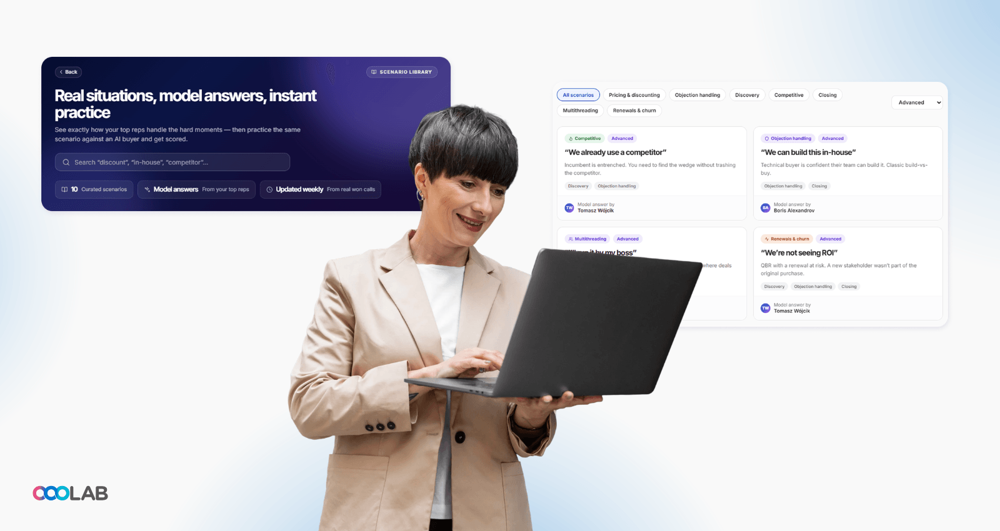
Skill Quotient AI, OOOLAB's AI-powered roleplay and assessment tool, was built for exactly this: giving reps unlimited, judgment-free repetition with instant feedback on the specific skill gap holding them back. Running that practice loop through a single corporate LMS, rather than scattered training decks, is what makes the reps and the feedback trackable at all. No mysterious "gift" required, just an Enterprise LMS built to make deliberate practice repeatable.
The "natural closer" makes for a good origin story, but it's a bad hiring strategy. The reps who outperform everyone else got there through structure: more reps, sharper feedback, and practice built around their actual weak spots. Organizations that build that structure into their sales training stop gambling on instinct and start compounding skill deliberately.
Ready to see AI roleplay and assessment in action? Book a free Skill Quotient OS demo and watch your team's training performance shift.
At OOOLAB (pronounced "u:laeb"), our mission is to make complex learning operations simple. We aim to positively impact the lives of over 1,000,000 learners and educators by the end of 2026. OOOLAB's LearningOS provides educational institutions and corporate enterprises with an all-in-one solution to create and deliver engaging learning experiences.
Dedicated success manager
Personalized setup
Ongoing assistance
Learn more at thelearningos.com
1. Are salespeople born or made?
Mostly made. Research on deliberate practice, starting with Ericsson's 1993 study, shows expert performance comes from structured, feedback-driven repetition rather than innate gift. Reps who look "naturally talented" almost always logged more deliberate practice than their peers.
2. What is deliberate practice, and how does it apply to sales?
Deliberate practice is structured, goal-oriented repetition that targets a specific weakness and includes immediate feedback. In sales, that looks like repeated roleplay on a specific objection type or pitch weakness, corrected in real time, rather than generic shadowing.
3. Can sales talent be measured or predicted before hiring?
Not reliably. Personality traits can hint at fit, but they don't predict skill level, since skill is built through training and repetition after hire, not selected for beforehand.
4. How does AI roleplay support deliberate practice in sales training?
AI roleplay gives reps unlimited, low-pressure repetitions with instant, targeted feedback, meeting all three requirements of deliberate practice: repetition, feedback, and progressive difficulty at scale.
5. Should companies hire for talent or train for skill?
Train for skill. Formal training programs correlate with significantly higher quota attainment and larger deal sizes than relying on hiring instinct alone, and structured training consistently delivers a strong return on investment.