
In today’s competitive sales landscape, one-size-fits-all approaches no longer work. Sales teams are diverse, with reps at different experience levels, handling varied products, and facing unique customer challenges. Personalized sales training addresses this by delivering tailored content that meets individual needs, accelerating skill development and boosting performance. An enterprise LMS makes this personalization scalable, using data and AI to create custom learning paths that drive real results.
This blog explores how personalized sales training transforms team effectiveness, with strategies, benefits, and data-backed insights. We’ll show why an enterprise LMS is essential for implementing tailored training at scale.

Traditional sales training often involves generic workshops or modules that assume all reps need the same information. This approach wastes time on irrelevant topics and leaves skill gaps unaddressed. Personalized sales training flips this model, using data to customize content based on role, performance, and goals.
A 2024 McKinsey report found that personalized learning improves employee performance by up to 32%. For sales teams, where quick skill application directly impacts revenue, personalization ensures reps focus on what matters most—whether mastering objection handling or advanced negotiation.
An enterprise LMS enables this shift by analyzing user data and delivering adaptive content, making personalized sales training accessible and efficient.
>>> Read more: Sales Training Demystified: Why It Matters More Than Ever
>>> Read more: Effective Onboarding Strategies for New Sales Hires: Setting Them Up for Success
Sales roles vary widely: new hires need foundational knowledge, while veterans require advanced strategies. Customers also differ by industry, size, and pain points. Generic sales training fails to account for these differences, leading to disengagement and poor retention.
Personalized sales training solves this by aligning learning with individual and organizational needs. It boosts motivation, as reps see direct relevance to their daily work. A 2025 LinkedIn Learning report showed that 94% of employees would stay longer at companies investing in personalized development.
Without personalization, sales training risks low completion rates and minimal impact. An enterprise LMS changes this by making tailored experiences the standard.
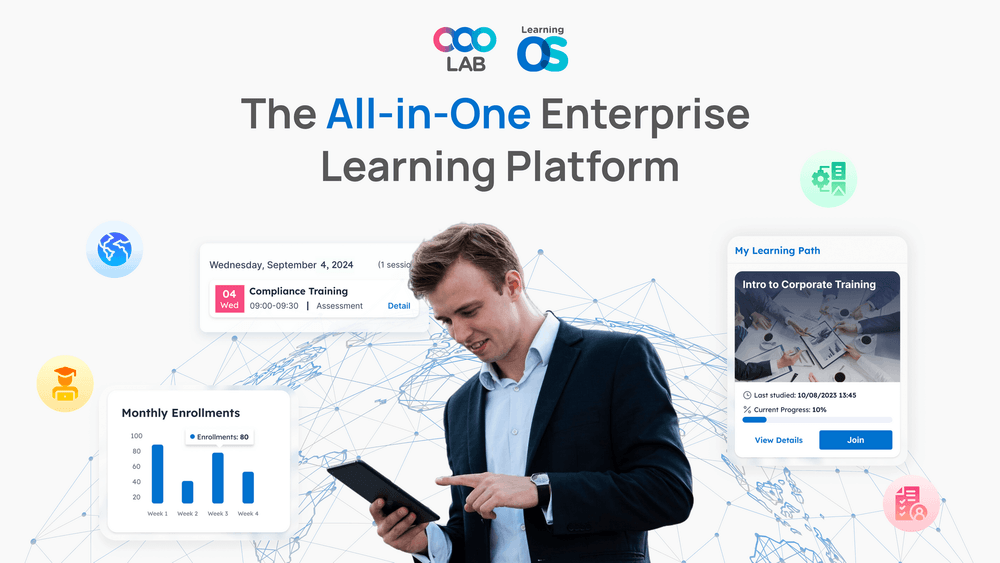
Book Free Demo with us. Bring your Training and Learning to a new height with LearningOS.
>>> Read more: Building Confidence in Your Sales Team Through Training and Development
>>> Read more: Addressing declining retail foot traffic issue
An enterprise LMS is the backbone of personalization, offering tools to assess, adapt, and deliver training effectively. Below are key ways it supports tailored sales training.
An enterprise LMS uses assessments and performance data to identify individual gaps. For example, a rep struggling with closing might receive targeted modules, while another excels there but needs upselling training. This data-driven approach ensures sales training addresses specific weaknesses.
AI-powered analytics predict future needs, recommending proactive content before gaps widen.
Personalized sales training creates dynamic paths that adjust based on progress. An enterprise LMS tracks quiz scores, module completion, and application, routing reps to advanced or remedial content. A high-performing rep might skip basics and dive into complex deal strategies.
This adaptability keeps training engaging and efficient, reducing time wasted on irrelevant topics.
Sales teams include account executives, SDRs, and managers with distinct needs. An enterprise LMS segments content by role, delivering relevant sales training. SDRs focus on prospecting, while executives learn strategic account management.
Role-based paths ensure every rep develops skills aligned with their responsibilities.
Personalized sales training incorporates microlearning—short, focused modules—that reps complete at their own pace. An enterprise LMS delivers bite-sized content on demand, like a quick video on handling price objections.
This flexibility fits busy schedules, improving completion rates and retention.
An enterprise LMS integrates with CRM systems like Salesforce, pulling real-time data to personalize sales training. Low close rates trigger negotiation modules, while strong pipeline activity suggests advanced forecasting training.
This integration ties learning directly to performance, maximizing relevance.
Personalized sales training uses gamification—badges, leaderboards, points—to motivate reps. An enterprise LMS customizes challenges based on individual progress, making learning competitive and fun.
Engagement features ensure reps stay committed, applying skills faster.
An enterprise LMS provides ongoing feedback through quizzes and manager reviews, refining sales training paths in real time. Reps see progress dashboards, fostering ownership of their development.
Continuous adjustment keeps training aligned with evolving needs.
>>> Read more: A guide to teaching sales rep positive response
>>> Read more: Why is employee upskilling non-negotiable for business success
Implementing personalized sales training with an enterprise LMS delivers powerful outcomes:
Faster Ramp-Up: New reps reach quota quicker with targeted onboarding.
Higher Performance: Tailored skills lead to better close rates and larger deals.
Increased Engagement: Relevant content boosts motivation and completion rates.
Better Retention: Employees feel valued, reducing turnover.
Measurable ROI: Analytics link sales training to revenue metrics.
These benefits make personalized sales training a strategic investment for sales organizations.
Personalized sales training is no longer optional—it’s essential for building high-performing sales teams. By tailoring content to individual needs with an enterprise LMS, organizations accelerate development, boost engagement, and drive revenue. From skill gap analysis to adaptive paths, personalization ensures every rep reaches their potential.
Embrace personalized sales training today to transform your salesforce. With an enterprise LMS, you’ll deliver relevant, impactful learning that powers sustained success.
At OOOLAB (pronounced 'uːlæb'), our mission is to make complex learning operations simple. We aim to positively impact the lives of over 1,000,000 learners and educators by the end of 2026.
OOOLAB's LearningOS provides educational institutions and corporate enterprises with an all-in-one solution to create and deliver engaging learning experiences.
We meet organizations' needs or support your growth. We provide undivided attention. We provide:
1. Dedicated success manager: We offer direct communication with a real human who'll discuss your enterprises unique learning operations and goals.
2. Personalized setup: Our team will help you transition to LearningOS on your schedule, one step at a time.
3. Around the clock support: Get help from us any time, and in any time zone.
We have recently launched a new AI training tool, Skill Quotient OS, designed to elevate hybrid training to new heights. It offers role-play exercises with scenarios and assessments.This tool can apply in sales training, corporate development and customer support training in any industry.
Reach out to us at: LinkedIn, Facebook, Instagram, Tiktok, X
LearningOS is a complete, enterprise-grade learning platform that’s secure, intuitive, and effective.
Core capabilities:
Course Creation & Management (CMS) – Build interactive and engaging courses and learning paths quickly without technical skills.
Training Delivery (LMS + LXP) – Deploy and manage training that learners actually want to complete. Track progress, manage certifications, and run your entire training operation from one place.
Mobile & Web Access (Learner Portal) – Learners can train anywhere, anytime, and on any device using iOS, Android, or desktop.
Enterprise Security – SOC 2 Type 2, ISO 27001, and GDPR certified to meet your compliance requirements.
What this means for you: One platform replaces multiple tools, your team launches training faster, and learners engage more because it’s easy to use.
1. Enterprise & Multinational Corporations – Employee development, compliance training, and onboarding across global teams.
2. Business Processing Outsourcing (BPO) — sales training, customer service, technical support training, customer product knowledge training
3. IT & Technical Services – Technical certifications, process training, and upskilling programs 4. that boost efficiency.
4. Technology & SaaS – Product training, technical support, technical training, and customer education for software companies.
5. Financial Services & Banking – Regulatory compliance, customer service training, and product knowledge for banks, insurance, and fintech companies.
6. Retail – Customer service, product knowledge, and sales training for store staff and new hires.
7. Manufacturing – Safety protocols, equipment operation, and certification/quality control training for employees, distributors, and partners.
8. Healthcare – Non-medical staff training, compliance certifications, and continuing education for hospitals and clinics.
9. Associations & Nonprofits – Member certifications, continuing education, and professional development programs.
10. Franchises & Multi-Location Businesses – Consistent training and onboarding across all locations for education centers, restaurants, hospitality, and retail chains.
LearningOS works for any organization that needs to train employees, partners, or customers at scale. Whether you’re just starting to formalize your training or replacing an outdated system, our platform grows with you.
LearningOS is an especially great fit for:
1. Mid-size to large companies with 500+ employees that need to train multiple groups—sales teams, customer success, partners, or compliance-heavy departments.
2. Companies using multiple training tools that want to consolidate. If different teams are paying for separate platforms, LearningOS can centralize everything and cut costs.
3. Organizations outgrowing their current LMS. If your system is slow, limiting, or can’t handle your growth, LearningOS scales without the headaches.
4. Membership organizations and associations that train large networks of partners, resellers, or franchisees across different regions.
5. Regulated industries like financial services, healthcare, and government that need strict security, compliance tracking, and custom configurations.
LearningOS was built to power enterprise learning at scale and supports organizations with more than 100,000+ employees. LearningsOS helps you manage the complexity of multi-regional operations, diverse compliance requirements, and varied learning needs. Whether you’re operating across 5 or 50 locations, you’ll maintain training consistency, ensure regulatory compliance, and upskill your entire workforce to achieve business goals. You can finally have your L&D become a revenue driver.
Typically, OOOLAB’s LearningOS is best suited for companies who are:
Training at least 500+ learners, which can represent a combination of clients, partners and employees.
On pace to outgrow their existing LMS and require a more sophisticated and flexible system that can match their organization’s growth trajectory.
Extending their L&D programs across multiple business units.
Possibly translating their learning content into other languages.
Organizations that meet these criteria find OOOLAB’s LearningOS extremely valuable for the price.
Leading Fortune 1000 enterprises and publicly-listed companies across 23 countries rely on LearningOS to maintain competitive advantage through continuous workforce development. With 3,000+ instructors and 250,000+ employees already on the platform, you’re joining organizations that have proven the ROI of strategic learning investment—reducing turnover, accelerating promotions from within, and building institutional knowledge that drives sustainable growth.
We’re a complete solution, not just software. You get the platform plus the support to actually achieve your training goals.
What sets us apart:
1. Dedicated Learning Consultant & Attentive Support – An experienced operator backed by a professional support team that knows your business and makes sure you’re getting real ROI and value, not just using features.
2. Professional Services team – If you need it, we can build your courses, create custom features, or develop integrations you need—so you’re not stuck doing it all yourself.
3. End-to-end partnership – From setup to scaling, we handle the heavy lifting so your team can focus on results, not troubleshooting.
Bottom line: You’re not buying software and figuring it out alone. You’re getting a partner invested in your success.
LearningOS pays for itself and helps you achieve your business goals by significantly reducing training overhead and directly improving business performance. Our clients see an average 3x ROI on their investment.
The impact:
More selling and better experiences, less admin – sales and CS teams spend time with customers, not stuck in training tasks.
Faster skill development – Close capability gaps in weeks, not months, so teams perform better sooner with more confidence and competence.
Lower training costs – Automate what used to require dedicated staff time and resources.
Proof of impact – Track exactly how training drives revenue, retention, and productivity with built-in analytics.
Real outcome: Higher revenue per employee, lower cost per trained worker, and data that proves training is actually working.
LearningOS supports many integrations, including:
Content authoring tools
HRIS systems
Single Sign-On (SSO)
CRM systems
Enterprise messaging platforms
LMS data warehouses
OOOLAB’s LearningOS team can also support (and build) custom integrations for virtually any software tool.
Most clients typically sign a 3-5 year contract with OOOLAB’s enterprise LearningOS. However, the minimum contract length is only a single year.
LearningOS uses a straightforward subscription model based on the number of users. You commit to a minimum number of user licenses for a set period (typically 1-5 years) and pay a monthly, quarterly, or annual fee per user. For example, you might commit to 500 users for 3 years at a fixed per-user rate.
Key points:
One subscription price for all user types – admins, instructors, and learners all count the same.
Volume discounts – Larger user commitments get lower per-user pricing.
Flexible scaling – If you exceed your committed user count, you’re only billed for the additional users at your contracted rate.
Predictable costs – Your per-user price stays fixed for the length of your contract.
LearningOS onboarding typically takes 3-12 weeks and follows these steps:
1. Consultation call – We discuss your training goals, who needs to be trained, and what success looks like (ROI/impact).
2. Requirements review – We identify which features, integrations, and customizations you need and by when.
3. You’ll see a customized demo using your actual use cases—not generic features.
4. Platform setup – We configure user roles, customize your interface, and connect to your existing systems (HRIS, CRM, SSO, etc.).
5. Content migration – We help move your existing courses, videos, quizzes, and user data into LearningOS.
6. Admin training – We train your team on how to create courses, manage users, and run reports.
7. Integration testing – We test all connections to ensure data flows smoothly between systems.
8. User import – We upload your learners in bulk or set up automated syncing from your HR system.
9. Quality check – We test everything to make sure the platform works exactly as you need.
10. Go-live support – Dedicated support during and after launch with fast response times to any issues.
11. Ongoing assistance – Additional training sessions, integration help, or professional services as your needs evolve.
12. Most clients see positive ROI within 6-12 months.
You can begin by scheduling a free consultation to assess your enterprise’s training needs and we’ll answer any questions you may have.