Companies with dedicated customer success teams see up to 25% higher net revenue retention than those without one (Source: Benchmarkit, 2025). Most training budgets never reach the teams driving that number.
Sales coaching gets the budget, the frameworks, and the leadership attention. Meanwhile, customer success, support, and account management teams, the people who determine whether a signed deal turns into a renewed or expanded one, are often left with onboarding decks and good intentions. Customer engagement doesn't stop at the handshake; it's a skill set that has to be built and maintained across every team a customer touches after the deal closes.
This gap tends to widen as companies scale. A growing customer base means more renewal conversations, more support escalations, and more accounts at risk of quiet churn. This article makes the case for extending sales coaching discipline, not just budget, to every team that touches a customer after the deal closes.
For most organizations, yes, and that's the problem. Sales coaching programs are structured, measured, and continuously refined. Post-sale training is often ad hoc: a product walkthrough here, a support ticket macro there, rarely a coordinated skill-building program.
The two groups need different things. Reps require proper coaching to open conversations, handle objections, and close. Customer-facing teams need to sustain relationships, read account health signals, and know when to escalate versus reassure. Treating both with the same generic content misses what each role actually demands.
Consider a support agent fielding a renewal-timed complaint. Without training in de-escalation and account context, that call can turn a resolvable issue into a lost contract. With it, the same call becomes a save, and sometimes an upsell conversation.
Focus Area | Sales Coaching Focus | Customer-Facing Training |
Primary goal | Win the deal | Retain and grow the account |
Core skill | Objection handling, negotiation | Active listening, de-escalation |
Training cadence | Pre-close, deal-specific | Ongoing, relationship-based |
Success metric | Win rate, deal velocity | Retention rate, expansion revenue |
Skipping post-sale training isn't a minor gap; it's a direct hit to revenue that's already been won. A combined 83.6% of customer success leaders expect to drive more expansion revenue in 2025 than they did the previous year (Source: Vitally, 2025). Untrained customer-facing teams struggle to capture that opportunity even when it's sitting in front of them.
Expansion revenue costs far less to generate than new business, but only if the team managing the relationship knows how to spot the moment and have the conversation. That's a trainable skill, the same discipline sales coaching already applies to closing, just aimed at a different moment in the relationship.
Account health signals, like declining feature usage or a spike in support tickets, are often visible weeks before a renewal conversation happens. Teams trained to read and act on those signals catch risk early instead of finding out during the renewal call itself.
If retention and engagement are a priority for your team, start here and see how LearningOS delivers both.
Emotional intelligence rarely shows up on a support team's training calendar, yet it's often the deciding factor in whether a frustrated customer stays or leaves. Active listening, tone control, and de-escalation are learnable competencies, the same way sales coaching already treats negotiation as learnable rather than innate.
Teams that treat these as soft, unstructured skills tend to under-invest in them, then wonder why churn spikes after a rough support interaction. Structured practice, not just tenure, is what builds consistency across a team.
Read more
>>> Emotional Intelligence in Sales Training: Building Stronger Connections
AI roleplay tools are usually pitched as sales coaching enablement, but the same mechanics apply to support and account teams. An AI LMS built for one function can typically extend to the others. Skill Quotient OS, OOOLAB's AI roleplay and assessment tool, is built for sales coaching, corporate development, and customer support training alike.
A support agent can rehearse a de-escalation scenario with scored feedback the same way a rep rehearses a negotiation. That risk-free repetition, without needing a manager to sit in on every call, is what turns a one-off coaching session into a consistent, team-wide standard.
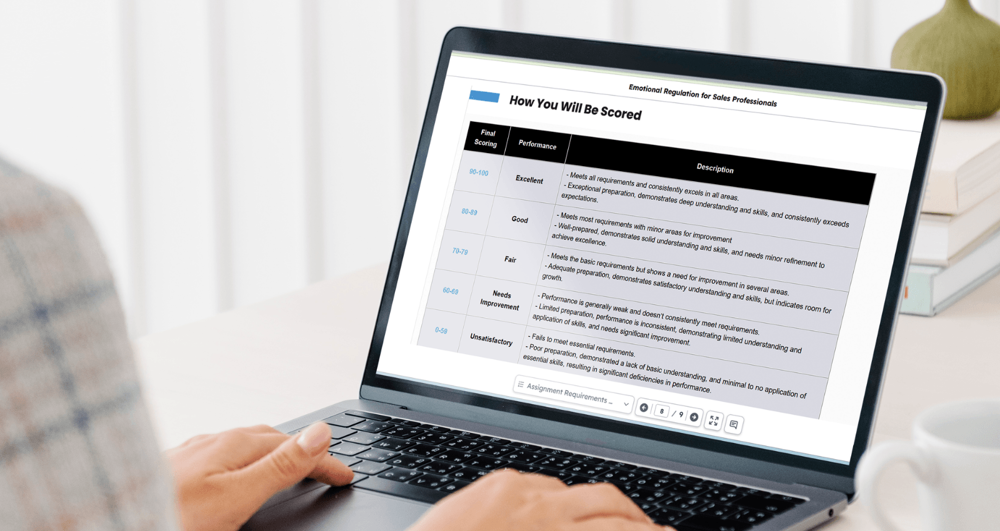
Competency-mapped scoring also gives managers a clear view of where a team is strong and where it isn't, instead of relying on a handful of overheard calls. That visibility makes coaching conversations specific rather than generic.

Employee engagement and training investment are closely linked, and that link doesn't stop at the sales floor. 90% of employees say they're more likely to stay at a company that invests in their growth (Source: LinkedIn Workplace Learning, 2025). Customer-facing teams notice when they're left out of that investment.
A shared learning platform across sales, success, and support gives leadership one place to see skill gaps, track completion, and connect coaching data to retention outcomes, instead of managing disconnected systems.
It also removes a quieter cost: the sense among customer-facing staff that they're an afterthought in the company's growth story. This isn't a single professional training course; it works best as an ongoing program. A shared platform signals that their role in retaining revenue matters as much as the role that won it.
Read more
>>> Employee Engagement Strategies for Your Enterprise LMS
>>> How Enterprise LMS Platforms Leverage AI for Personalized Learning
The revenue a sales team wins is only as durable as the team that manages it afterward. Sales coaching gets a rep to the close; extending that same practice and feedback to customer success, support, and account teams protects the revenue once it's signed.
Start with the account most at risk of quiet churn this quarter, and ask whether the team managing it has had the same training investment as the team that sold it.
Built for L&D leaders who need results, not more admin. Book your free demo and bring your learning operations up to speed.
At OOOLAB (pronounced "u:laeb"), our mission is to make complex learning operations simple. We aim to positively impact the lives of over 1,000,000 learners and educators by the end of 2026. OOOLAB's LearningOS provides educational institutions and corporate enterprises with an all-in-one solution to create and deliver engaging learning experiences.
Dedicated success manager
Personalized setup
Ongoing assistance
Learn more at thelearningos.com
1. What is customer-facing team training beyond sales?
It's structured training for customer success, support, and account management teams, the roles that manage a customer relationship after a deal closes. It covers soft skills like active listening and de-escalation, account health monitoring, and product knowledge, rather than deal-closing skills alone.
2. How does customer engagement training affect retention?
Teams trained in relationship management and de-escalation are better equipped to prevent churn before it happens. Companies with dedicated, well-trained customer success functions report up to 25% higher net revenue retention than those without.
3. Can AI roleplay tools train support and account teams, not just sales reps?
Yes. Tools like Skill Quotient OS apply the same scenario-based, scored practice model used in sales training to customer support scenarios, letting agents rehearse de-escalation and account conversations with consistent feedback.
4. What skills matter most for post-sale customer-facing roles?
Active listening, tone control, de-escalation, and the ability to read account health signals matter more than product trivia alone. These are trainable skills, not fixed personality traits.
5. How do you measure ROI on customer success training?
Track net revenue retention, expansion revenue, and churn rate before and after training rollout, the same way sales teams track win rate against training investment. LearningOS clients typically see positive training ROI within 6 to 12 months.