Sales teams in B2B and B2C environments face distinct challenges, and tailoring sales training to these differences is crucial for success. B2B sales often involve complex, long-term relationships with multiple stakeholders, while B2C focuses on quick, consumer-driven transactions. Understanding these nuances ensures that sales training programs are effective, boosting performance, revenue, and team morale. As businesses adapt to evolving markets, investing in targeted sales training becomes a strategic imperative.
This blog examines the key differences in sales training for B2B and B2C, with data-driven insights and practical strategies. We’ll explore how to optimize sales training to meet each model's unique demands, helping leaders build high-performing teams.

B2B sales involve selling products or services to other businesses, often through extended negotiations and customized solutions. B2C sales target individual consumers, emphasizing quick decisions and emotional appeals. These models shape how sales reps operate, influencing everything from prospecting to closing.
Sales training must align with these dynamics to be effective. A 2024 Gartner report highlights that 65% of B2B buyers expect personalized experiences, compared to 45% in B2C, underscoring the need for tailored approaches. By focusing on model-specific skills, sales training enhances rep confidence and outcomes.
>>> Read more: Sales Training Demystified: Why It Matters More Than Ever
>>> Read more: Effective Onboarding Strategies for New Sales Hires: Setting Them Up for Success
Sales training for B2B and B2C differs in focus, methodology, and goals. Below are the primary distinctions.
In B2B, sales training emphasizes long-term relationship building, teaching reps to nurture leads through multiple touchpoints and value-based selling. Reps learn to identify decision-makers, address pain points, and provide ROI-focused solutions. B2C sales training prioritizes quick engagement, focusing on emotional triggers, product benefits, and closing techniques for immediate purchases.
A 2023 McKinsey study shows B2B sales cycles average 6-9 months, while B2C is often days or hours, requiring distinct training emphases. Effective sales training in B2B includes role-playing complex negotiations, while B2C drills rapid objection handling.
B2B products are often technical or customized, so sales training dives deep into product knowledge, industry expertise, and consultative selling. Reps must explain how solutions integrate with buyer operations. B2C products are simpler, with training centered on features, benefits, and upselling tactics.
Sales training in B2B uses case studies and demos to build credibility, while B2C employs storytelling and visual aids. This difference ensures reps convey value appropriately.
B2B sales involve multiple stakeholders, so training teaches mapping influencers and tailoring pitches. Sales training includes CRM tools for tracking interactions. B2C focuses on consumer psychology, training reps on impulse buying, social proof, and personalization.
A 2024 Forrester report notes 75% of B2B deals involve 6+ stakeholders, versus B2C's single buyer focus. Sales training adapts to these realities for better outcomes.
B2B sales training stresses pipeline management and long-term metrics like customer lifetime value. B2C prioritizes short-term KPIs like conversion rates. An enterprise LMS tracks these metrics, providing data for refinement.
Sales training programs must incorporate model-specific analytics to measure success effectively.
B2B teams are often distributed, requiring scalable sales training via online platforms. B2C teams, frequently field-based, benefit from mobile-friendly content. An enterprise LMS ensures accessibility, with gamification for engagement. This scalability makes sales training efficient for both models.
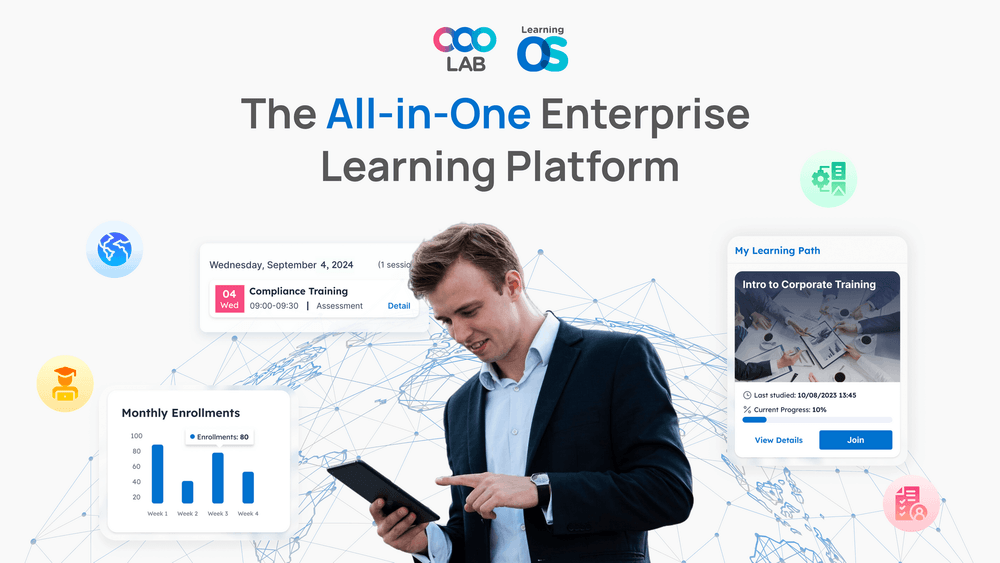
Book Free Demo with us. Bring your Training and Learning to a new height with LearningOS.
>>> Read more: Building Confidence in Your Sales Team Through Training and Development
>>> Read more: Addressing declining retail foot traffic issue
B2B sales training must build consultative skills and strategic thinking. Below are key strategies.
Train reps to act as advisors, focusing on buyer needs. Sales training modules on active listening and solution mapping are essential. Role-playing helps reps practice.
Use CRM integration in sales training to teach data-driven selling. An enterprise LMS provides analytics to track rep progress and refine programs.
B2B training emphasizes post-sale relationships. Modules on upselling and retention boost customer loyalty.
Sales training teaches patience and nurturing, with strategies for maintaining momentum through content marketing and follow-ups.
Track metrics like deal velocity and lifetime value to evaluate sales training effectiveness.
>>> Read more: A guide to teaching sales rep positive response
>>> Read more: Why is employee upskilling non-negotiable for business success
B2C sales training focuses on speed, persuasion, and customer experience. Below are essential strategies.
Train reps on opening hooks and emotional appeals. Sales training includes scripts and demos for fast rapport.
B2C training teaches narrative techniques to showcase benefits. Visual aids and customer testimonials are key.
Sales training modules on identifying opportunities boost average transaction value.
Train on e-commerce platforms and social selling. Mobile apps in sales training ensure accessibility.
Measure success through conversion rates and customer feedback to refine sales training.
Understanding the differences in sales training for B2B and B2C is essential for building effective teams. B2B requires depth and relationship focus, while B2C emphasizes speed and emotion. By tailoring programs and using an enterprise LMS, organizations can optimize sales training for better results.
Invest in model-specific sales training today to empower your team. With the right approach, you'll navigate unique challenges and achieve sustained success.
At OOOLAB (pronounced 'uːlæb'), our mission is to make complex learning operations simple. We aim to positively impact the lives of over 1,000,000 learners and educators by the end of 2026.
OOOLAB's LearningOS provides educational institutions and corporate enterprises with an all-in-one solution to create and deliver engaging learning experiences.
We meet organizations' needs or support your growth. We provide undivided attention. We provide:
1. Dedicated success manager: We offer direct communication with a real human who'll discuss your enterprises unique learning operations and goals.
2. Personalized setup: Our team will help you transition to LearningOS on your schedule, one step at a time.
3. Around the clock support: Get help from us any time, and in any time zone.
We have recently launched a new AI training tool, Skill Quotient OS, designed to elevate hybrid training to new heights. It offers role-play exercises with scenarios and assessments.This tool can apply in sales training, corporate development and customer support training in any industry.
Reach out to us at: LinkedIn, Facebook, Instagram, Tiktok, X
LearningOS is a complete, enterprise-grade learning platform that’s secure, intuitive, and effective.
Core capabilities:
Course Creation & Management (CMS) – Build interactive and engaging courses and learning paths quickly without technical skills.
Training Delivery (LMS + LXP) – Deploy and manage training that learners actually want to complete. Track progress, manage certifications, and run your entire training operation from one place.
Mobile & Web Access (Learner Portal) – Learners can train anywhere, anytime, and on any device using iOS, Android, or desktop.
Enterprise Security – SOC 2 Type 2, ISO 27001, and GDPR certified to meet your compliance requirements.
What this means for you: One platform replaces multiple tools, your team launches training faster, and learners engage more because it’s easy to use.
1. Enterprise & Multinational Corporations – Employee development, compliance training, and onboarding across global teams.
2. Business Processing Outsourcing (BPO) — sales training, customer service, technical support training, customer product knowledge training
3. IT & Technical Services – Technical certifications, process training, and upskilling programs 4. that boost efficiency.
4. Technology & SaaS – Product training, technical support, technical training, and customer education for software companies.
5. Financial Services & Banking – Regulatory compliance, customer service training, and product knowledge for banks, insurance, and fintech companies.
6. Retail – Customer service, product knowledge, and sales training for store staff and new hires.
7. Manufacturing – Safety protocols, equipment operation, and certification/quality control training for employees, distributors, and partners.
8. Healthcare – Non-medical staff training, compliance certifications, and continuing education for hospitals and clinics.
9. Associations & Nonprofits – Member certifications, continuing education, and professional development programs.
10. Franchises & Multi-Location Businesses – Consistent training and onboarding across all locations for education centers, restaurants, hospitality, and retail chains.
LearningOS works for any organization that needs to train employees, partners, or customers at scale. Whether you’re just starting to formalize your training or replacing an outdated system, our platform grows with you.
LearningOS is an especially great fit for:
1. Mid-size to large companies with 500+ employees that need to train multiple groups—sales teams, customer success, partners, or compliance-heavy departments.
2. Companies using multiple training tools that want to consolidate. If different teams are paying for separate platforms, LearningOS can centralize everything and cut costs.
3. Organizations outgrowing their current LMS. If your system is slow, limiting, or can’t handle your growth, LearningOS scales without the headaches.
4. Membership organizations and associations that train large networks of partners, resellers, or franchisees across different regions.
5. Regulated industries like financial services, healthcare, and government that need strict security, compliance tracking, and custom configurations.
LearningOS was built to power enterprise learning at scale and supports organizations with more than 100,000+ employees. LearningsOS helps you manage the complexity of multi-regional operations, diverse compliance requirements, and varied learning needs. Whether you’re operating across 5 or 50 locations, you’ll maintain training consistency, ensure regulatory compliance, and upskill your entire workforce to achieve business goals. You can finally have your L&D become a revenue driver.
Typically, OOOLAB’s LearningOS is best suited for companies who are:
Training at least 500+ learners, which can represent a combination of clients, partners and employees.
On pace to outgrow their existing LMS and require a more sophisticated and flexible system that can match their organization’s growth trajectory.
Extending their L&D programs across multiple business units.
Possibly translating their learning content into other languages.
Organizations that meet these criteria find OOOLAB’s LearningOS extremely valuable for the price.
Leading Fortune 1000 enterprises and publicly-listed companies across 23 countries rely on LearningOS to maintain competitive advantage through continuous workforce development. With 3,000+ instructors and 250,000+ employees already on the platform, you’re joining organizations that have proven the ROI of strategic learning investment—reducing turnover, accelerating promotions from within, and building institutional knowledge that drives sustainable growth.
We’re a complete solution, not just software. You get the platform plus the support to actually achieve your training goals.
What sets us apart:
1. Dedicated Learning Consultant & Attentive Support – An experienced operator backed by a professional support team that knows your business and makes sure you’re getting real ROI and value, not just using features.
2. Professional Services team – If you need it, we can build your courses, create custom features, or develop integrations you need—so you’re not stuck doing it all yourself.
3. End-to-end partnership – From setup to scaling, we handle the heavy lifting so your team can focus on results, not troubleshooting.
Bottom line: You’re not buying software and figuring it out alone. You’re getting a partner invested in your success.
LearningOS pays for itself and helps you achieve your business goals by significantly reducing training overhead and directly improving business performance. Our clients see an average 3x ROI on their investment.
The impact:
More selling and better experiences, less admin – sales and CS teams spend time with customers, not stuck in training tasks.
Faster skill development – Close capability gaps in weeks, not months, so teams perform better sooner with more confidence and competence.
Lower training costs – Automate what used to require dedicated staff time and resources.
Proof of impact – Track exactly how training drives revenue, retention, and productivity with built-in analytics.
Real outcome: Higher revenue per employee, lower cost per trained worker, and data that proves training is actually working.
LearningOS supports many integrations, including:
Content authoring tools
HRIS systems
Single Sign-On (SSO)
CRM systems
Enterprise messaging platforms
LMS data warehouses
OOOLAB’s LearningOS team can also support (and build) custom integrations for virtually any software tool.
Most clients typically sign a 3-5 year contract with OOOLAB’s enterprise LearningOS. However, the minimum contract length is only a single year.
LearningOS uses a straightforward subscription model based on the number of users. You commit to a minimum number of user licenses for a set period (typically 1-5 years) and pay a monthly, quarterly, or annual fee per user. For example, you might commit to 500 users for 3 years at a fixed per-user rate.
Key points:
One subscription price for all user types – admins, instructors, and learners all count the same.
Volume discounts – Larger user commitments get lower per-user pricing.
Flexible scaling – If you exceed your committed user count, you’re only billed for the additional users at your contracted rate.
Predictable costs – Your per-user price stays fixed for the length of your contract.
LearningOS onboarding typically takes 3-12 weeks and follows these steps:
1. Consultation call – We discuss your training goals, who needs to be trained, and what success looks like (ROI/impact).
2. Requirements review – We identify which features, integrations, and customizations you need and by when.
3. You’ll see a customized demo using your actual use cases—not generic features.
4. Platform setup – We configure user roles, customize your interface, and connect to your existing systems (HRIS, CRM, SSO, etc.).
5. Content migration – We help move your existing courses, videos, quizzes, and user data into LearningOS.
6. Admin training – We train your team on how to create courses, manage users, and run reports.
7. Integration testing – We test all connections to ensure data flows smoothly between systems.
8. User import – We upload your learners in bulk or set up automated syncing from your HR system.
9. Quality check – We test everything to make sure the platform works exactly as you need.
10. Go-live support – Dedicated support during and after launch with fast response times to any issues.
11. Ongoing assistance – Additional training sessions, integration help, or professional services as your needs evolve.
12. Most clients see positive ROI within 6-12 months.
You can begin by scheduling a free consultation to assess your enterprise’s training needs and we’ll answer any questions you may have.