Gartner projects that 40% of enterprise applications will carry task-specific AI agents by the end of 2026, up from under 5% in 2025 (Source: Gartner, 2025). Sales enablement leaders are feeling that shift firsthand, mostly through vendor decks that use the word "agentic" like it's decoration.
Most platforms sold as an Enterprise LMS with "AI Powered LMS" features still need a human to click "assign," review the score, and decide what happens next. That is not autonomy.
This guide explores what agentic capability actually means for enablement teams managing reps at scale, supported by data-driven insights.
Agentic AI is a system that detects a condition, decides on an action, and executes it, all without a person triggering the step. A co-pilot, by contrast, only acts when a human asks it to.
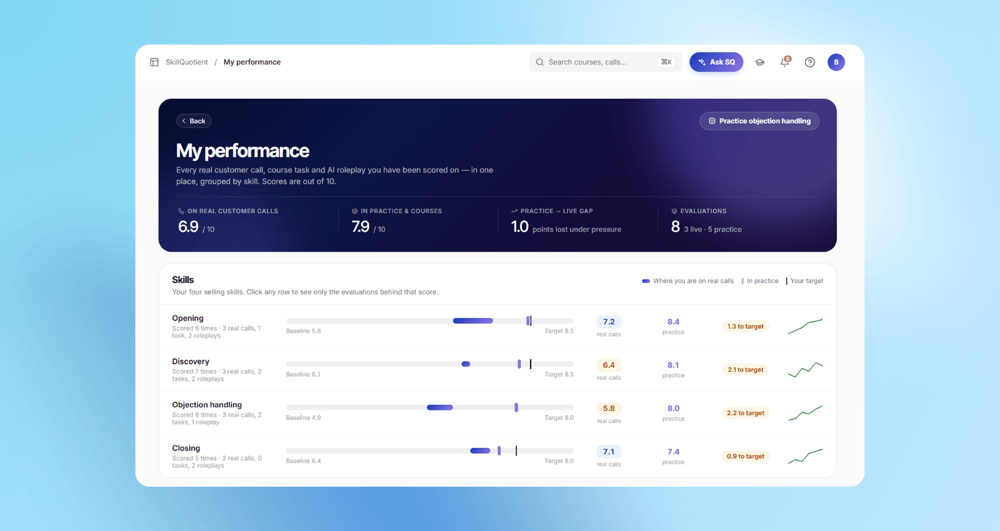
In an AI Powered LMS, this plays out as a closed loop: the system reads a signal (a missed objection, a failed assessment), decides what training fixes it, assigns it, and checks whether the behavior actually changed. No manager opens a dashboard to make any of that happen. That's the bar. Most tools marketed as "AI-powered" clear a much lower one.
Here's the cleanest way to separate the two: a co-pilot makes a human faster at a task, while agentic AI removes the human from the task loop entirely. Gartner projects that at least 15% of day-to-day work decisions will be made autonomously through agentic AI by 2028, up from effectively zero in 2024 (Source: Gartner, 2025). A co-pilot can't move that number. Only a system that acts on its own can.
The difference isn't just speed, it's accountability. A co-pilot leaves the human responsible for the outcome. Agentic AI shifts that responsibility to the system and the policies governing it. For an enablement leader, that's the real question buried under the buzzword: when your AI Powered LMS flags a rep's weak discovery skills, does a person have to notice and act, or does the system already have?
Ready to see AI roleplay and assessment in action? Book a free Skill Quotient OS demo and watch your team's training performance shift.
Not every vendor demo that says "AI" means the same thing. Sort what you're evaluating into one of three tiers before you sign anything.
Tier | What triggers action | Example |
Manual AI-assisted | A person, every time | Manager manually reviews a call, then manually assigns a course |
Co-pilot | A person, with AI help | AI suggests which course to assign; manager still clicks "send" |
Agentic | The system itself | AI detects the gap, assigns training, and re-tests without a click |
If a demo can't show you the third row happening live, on a real trigger, it isn't agentic. It's a co-pilot with better marketing.
Read more
>>> GenAI Co-Pilots in Your AI LMS
>>> The Future of AI LMS: Personalized Learning at Scale
Picture a rep wraps a discovery call and fumbles a pricing objection. In a genuinely agentic setup, the system flags that specific gap within the transcript, assigns a targeted roleplay scenario built around that exact objection, and schedules a re-test, all before the rep's next 1:1 with their manager. Nobody opened the dashboard. Nobody remembered to follow up.
That loop matters because sellers who work effectively with AI-supported coaching are 3.7 times more likely to hit quota (Source: Gartner Seller Skills Survey, 2024). Manual review can't scale to catch every gap across a distributed team; an autonomous loop doesn't need to scale, because it's already running on every call.
Read more
>>> AI Sales Roleplay: The Missing Link Between Training Investment and Revenue Results
>>> How AI-Driven LMS Solutions Personalize Skill Development for Employees
>>> Leveraging Sales Enablement Analytics to Refine Training Strategies
Vendor demos are built to impress, not to expose the gap between "assisted" and "autonomous." Ask these before you sign:
Can the system trigger an action (assignment, reassignment, escalation) without a human clicking anything first?
What specific signal starts the loop, and can you see it happening on a real call, live?
Does the system verify whether the rep's behavior actually changed, or does it just mark the training as "completed"?
Who is accountable if the system assigns the wrong coaching, the vendor's policy layer or your manager's judgment?
What security certifications govern the data an autonomous agent touches, and who audits its decisions?
If a vendor can't answer the first two clearly, you're looking at an Enterprise LMS with a chatbot, not an agentic one.
The gap between "AI-powered" and truly agentic is where most enablement budgets get wasted on tools that still require constant babysitting. Teams that get this right free up manager time for actual coaching conversations, not chasing dashboards. Visa saw a 78% increase in seller confidence after introducing AI-powered pitch training and coaching (Source: LinkedIn Learning Workplace Learning Report, 2025), and that kind of shift only happens when the system carries its own weight. LearningOS's Skill Quotient OS was built for exactly this: AI-driven roleplay and assessment aimed at closing that loop, not just flagging it.
Curious what an all-in-one LMS actually looks like in practice? Book a walkthrough: no commitment, just clarity.
At OOOLAB (pronounced "u:laeb"), our mission is to make complex learning operations simple. We aim to positively impact the lives of over 1,000,000 learners and educators by the end of 2026. OOOLAB's LearningOS provides educational institutions and corporate enterprises with an all-in-one solution to create and deliver engaging learning experiences.
Dedicated success manager
Personalized setup
Ongoing assistance
Learn more at thelearningos.com
1. What is agentic AI in learning and development?
Agentic AI in L&D refers to a system that detects a condition, such as a skill gap or a failed assessment, and takes action on its own, without a person triggering the step. It plans, executes, and verifies outcomes rather than just responding to a request.
2. What's the difference between agentic AI and a co-pilot in an LMS?
A co-pilot assists a human who still initiates and owns every action. Agentic AI runs the full loop itself, from detection to action to verification, which is why Gartner projects agentic systems will handle at least 15% of day-to-day work decisions autonomously by 2028 (Source: Gartner, 2025).
3. How does agentic AI actually work in sales coaching?
In sales enablement, an agentic system reads a call transcript, identifies a specific gap like a mishandled objection, assigns a targeted roleplay scenario built around that gap, and schedules a re-test, all without a manager manually reviewing the call first.
4. Is "agentic AI" the same thing as an AI-powered LMS?
Not automatically. Many platforms marketed as an AI-powered LMS use AI for suggestions or summaries, which makes them a co-pilot, not an agentic system. True agentic capability requires the platform to trigger actions on its own.
5. How do I check if a vendor's "agentic AI" claim is real?
Ask the vendor to demo a real trigger live: a skill gap being detected, training being assigned automatically, and a re-test being scheduled, with no one clicking a button in between. If they can't show that third step happening without human input, it's a co-pilot.