Selecting the appropriate Enterprise LMS has become a strategic decision for organizations that want to build scalable, future-ready learning programs. With the global learning management system market valued at approximately USD 28-29 billion in 2025 and projected to grow at a compound annual growth rate (CAGR) of 17-20% through the early 2030s, the choice of platform directly influences training effectiveness, employee engagement, compliance performance, and ultimately return on learning investment.
This comprehensive guide examines the essential features modern Enterprise LMS platforms should offer in 2026 and beyond, explains why each matters, and helps decision-makers compare solutions more effectively.

The defining characteristic of any true Enterprise LMS is its ability to serve thousands — sometimes tens of thousands — of concurrent users without degradation in performance.
Modern enterprise-grade platforms utilize cloud-native architecture (usually multi-tenant SaaS) that automatically scales computing resources based on demand. This elastic scaling becomes particularly valuable during major company-wide rollouts, mandatory compliance training windows, or global onboarding periods.
Key scalability aspects to evaluate include:
Maximum concurrent users supported without performance degradation
Automatic load balancing and geographic distribution of content delivery networks (CDN)
Database architecture capable of handling millions of learning records
API rate limits and concurrent integration capacity
Organizations planning significant workforce growth or seasonal training peaks should prioritize platforms that demonstrate proven scalability at 50,000+ active users.
>>> Read more: What is an Enterprise LMS
>>> Read more: Customization Options for Enterprise LMS
One-size-fits-all training belongs to the past. Contemporary Enterprise LMS platforms leverage artificial intelligence to create highly personalized learning experiences.
Essential personalization capabilities include:
AI-driven learning path recommendations based on role, performance history, skill gaps, and career aspirations
Adaptive sequencing that adjusts difficulty and content type according to learner mastery
Dynamic content assembly — pulling different resources for the same topic depending on learner profile
Predictive nudges and just-in-time microlearning recommendations
A 2025 Elearning Industry analysis showed that organizations using AI-personalized learning paths experienced approximately 67% higher completion rates and 56% better knowledge retention compared to linear training approaches.
>>> Read more: Common challenges when implementing an Enterprise LMS
>>> Read more: Steps to implement an Enterprise LMS
>>> Read more: Enterprise LMS - revolutionizing corporate training and development
Book Free Demo with us. Bring your Training and Learning to a new height with LearningOS.
No Enterprise LMS exists in isolation. Seamless integration with the organization's existing technology stack has become a non-negotiable requirement.
Critical integration categories include:
Human Capital Management (HCM) / HRIS systems (Workday, SAP SuccessFactors, Oracle HCM, UKG)
Single Sign-On (SSO) and identity providers (Okta, Azure AD, Ping Identity)
Performance management and talent platforms
Collaboration tools (Microsoft Teams, Slack) for social and embedded learning
Video conferencing (Zoom, Teams) for live virtual instructor-led training
Content authoring tools and third-party content libraries
CRM and customer success platforms (for customer/partner training use cases)
Platforms offering pre-built connectors, robust REST APIs, and webhook capabilities significantly reduce implementation time and ongoing maintenance costs.
Modern Enterprise LMS platforms must function as learning intelligence hubs, not just content delivery systems.
Essential analytics capabilities include:
Individual, team, department, and organization-wide completion & engagement metrics
Skills heatmap and skills gap analysis
Correlation between learning activities and business KPIs (sales performance, quality scores, safety incidents, customer satisfaction)
Predictive analytics forecasting future skill shortages
Customizable dashboards and scheduled executive reports
Organizations that effectively connect learning data to business outcomes typically demonstrate stronger justification for learning investments and faster program iteration.
The ability to efficiently produce, organize, and update learning content directly affects program agility.
Important content-related features include:
Built-in authoring tools supporting interactive elements, branching scenarios, and assessments
Support for multiple content formats (SCORM/xAPI/cmi5, video, documents, podcasts)
Robust tagging, metadata, and search capabilities
Version control and content approval workflows
AI-assisted content creation and translation features (increasingly important for global organizations)
Content curation and playlist capabilities
In 2025-2026, the most advanced Enterprise LMS platforms incorporate generative AI tools that help subject matter experts create initial drafts of learning content significantly faster than traditional methods.
Modern workforces expect to learn when and where it's convenient.
Essential mobile capabilities include:
Fully responsive design or native mobile applications
Offline access with automatic synchronization
Mobile-specific interactions (push notifications, microlearning, location-based learning)
Consistent experience across phones, tablets, laptops, and desktops
Organizations with significant frontline or field-based workforces particularly benefit from strong mobile Enterprise LMS capabilities.
Enterprise buyers must ensure the platform meets stringent security requirements.
Important security features include:
SOC 2 Type II, ISO 27001, GDPR, CCPA, and other relevant compliance certifications
Data encryption at rest and in transit
Role-based access control with granular permissions
Single Sign-On and multi-factor authentication
Regular penetration testing and vulnerability management programs
Data residency options for organizations with geographic restrictions
The Enterprise LMS market continues to evolve rapidly, with significant innovation occurring in AI-driven personalization, skills intelligence, and analytics. Organizations that choose platforms aligned with both today's requirements and tomorrow's possibilities will gain substantial competitive advantage through a more capable, adaptable workforce.
At OOOLAB (pronounced 'uːlæb'), our mission is to make complex learning operations simple. We aim to positively impact the lives of over 1,000,000 learners and educators by the end of 2026.
OOOLAB's LearningOS provides educational institutions and corporate enterprises with an all-in-one solution to create and deliver engaging learning experiences.
We meet organizations' needs or support your growth. We provide undivided attention. We provide:
1. Dedicated success manager: We offer direct communication with a real human who'll discuss your enterprises unique learning operations and goals.
2. Personalized setup: Our team will help you transition to LearningOS on your schedule, one step at a time.
3. Around the clock support: Get help from us any time, and in any time zone.
We have recently launched a new AI training tool, Skill Quotient OS, designed to elevate hybrid training to new heights. It offers role-play exercises with scenarios and assessments.This tool can apply in sales training, corporate development and customer support training in any industry.
Reach out to us at: LinkedIn, Facebook, Instagram, Tiktok, X
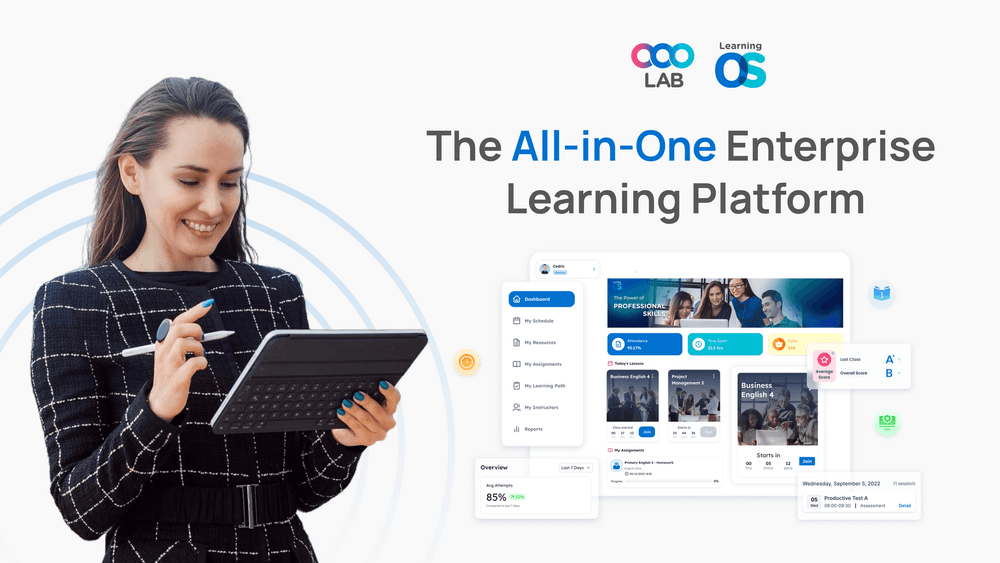
LearningOS is a complete, enterprise-grade learning platform that’s secure, intuitive, and effective.
Core capabilities:
Course Creation & Management (CMS) – Build interactive and engaging courses and learning paths quickly without technical skills.
Training Delivery (LMS + LXP) – Deploy and manage training that learners actually want to complete. Track progress, manage certifications, and run your entire training operation from one place.
Mobile & Web Access (Learner Portal) – Learners can train anywhere, anytime, and on any device using iOS, Android, or desktop.
Enterprise Security – SOC 2 Type 2, ISO 27001, and GDPR certified to meet your compliance requirements.
What this means for you: One platform replaces multiple tools, your team launches training faster, and learners engage more because it’s easy to use.
1. Enterprise & Multinational Corporations – Employee development, compliance training, and onboarding across global teams.
2. Business Processing Outsourcing (BPO) — sales training, customer service, technical support training, customer product knowledge training
3. IT & Technical Services – Technical certifications, process training, and upskilling programs 4. that boost efficiency.
4. Technology & SaaS – Product training, technical support, technical training, and customer education for software companies.
5. Financial Services & Banking – Regulatory compliance, customer service training, and product knowledge for banks, insurance, and fintech companies.
6. Retail – Customer service, product knowledge, and sales training for store staff and new hires.
7. Manufacturing – Safety protocols, equipment operation, and certification/quality control training for employees, distributors, and partners.
8. Healthcare – Non-medical staff training, compliance certifications, and continuing education for hospitals and clinics.
9. Associations & Nonprofits – Member certifications, continuing education, and professional development programs.
10. Franchises & Multi-Location Businesses – Consistent training and onboarding across all locations for education centers, restaurants, hospitality, and retail chains.
LearningOS works for any organization that needs to train employees, partners, or customers at scale. Whether you’re just starting to formalize your training or replacing an outdated system, our platform grows with you.
LearningOS is an especially great fit for:
1. Mid-size to large companies with 500+ employees that need to train multiple groups—sales teams, customer success, partners, or compliance-heavy departments.
2. Companies using multiple training tools that want to consolidate. If different teams are paying for separate platforms, LearningOS can centralize everything and cut costs.
3. Organizations outgrowing their current LMS. If your system is slow, limiting, or can’t handle your growth, LearningOS scales without the headaches.
4. Membership organizations and associations that train large networks of partners, resellers, or franchisees across different regions.
5. Regulated industries like financial services, healthcare, and government that need strict security, compliance tracking, and custom configurations.
LearningOS was built to power enterprise learning at scale and supports organizations with more than 100,000+ employees. LearningsOS helps you manage the complexity of multi-regional operations, diverse compliance requirements, and varied learning needs. Whether you’re operating across 5 or 50 locations, you’ll maintain training consistency, ensure regulatory compliance, and upskill your entire workforce to achieve business goals. You can finally have your L&D become a revenue driver.
Typically, OOOLAB’s LearningOS is best suited for companies who are:
Training at least 500+ learners, which can represent a combination of clients, partners and employees.
On pace to outgrow their existing LMS and require a more sophisticated and flexible system that can match their organization’s growth trajectory.
Extending their L&D programs across multiple business units.
Possibly translating their learning content into other languages.
Organizations that meet these criteria find OOOLAB’s LearningOS extremely valuable for the price.
Leading Fortune 1000 enterprises and publicly-listed companies across 23 countries rely on LearningOS to maintain competitive advantage through continuous workforce development. With 3,000+ instructors and 250,000+ employees already on the platform, you’re joining organizations that have proven the ROI of strategic learning investment—reducing turnover, accelerating promotions from within, and building institutional knowledge that drives sustainable growth.
We’re a complete solution, not just software. You get the platform plus the support to actually achieve your training goals.
What sets us apart:
1. Dedicated Learning Consultant & Attentive Support – An experienced operator backed by a professional support team that knows your business and makes sure you’re getting real ROI and value, not just using features.
2. Professional Services team – If you need it, we can build your courses, create custom features, or develop integrations you need—so you’re not stuck doing it all yourself.
3. End-to-end partnership – From setup to scaling, we handle the heavy lifting so your team can focus on results, not troubleshooting.
Bottom line: You’re not buying software and figuring it out alone. You’re getting a partner invested in your success.
LearningOS pays for itself and helps you achieve your business goals by significantly reducing training overhead and directly improving business performance. Our clients see an average 3x ROI on their investment.
The impact:
More selling and better experiences, less admin – sales and CS teams spend time with customers, not stuck in training tasks.
Faster skill development – Close capability gaps in weeks, not months, so teams perform better sooner with more confidence and competence.
Lower training costs – Automate what used to require dedicated staff time and resources.
Proof of impact – Track exactly how training drives revenue, retention, and productivity with built-in analytics.
Real outcome: Higher revenue per employee, lower cost per trained worker, and data that proves training is actually working.
LearningOS supports many integrations, including:
Content authoring tools
HRIS systems
Single Sign-On (SSO)
CRM systems
Enterprise messaging platforms
LMS data warehouses
OOOLAB’s LearningOS team can also support (and build) custom integrations for virtually any software tool.
Most clients typically sign a 3-5 year contract with OOOLAB’s enterprise LearningOS. However, the minimum contract length is only a single year.
LearningOS uses a straightforward subscription model based on the number of users. You commit to a minimum number of user licenses for a set period (typically 1-5 years) and pay a monthly, quarterly, or annual fee per user. For example, you might commit to 500 users for 3 years at a fixed per-user rate.
Key points:
One subscription price for all user types – admins, instructors, and learners all count the same.
Volume discounts – Larger user commitments get lower per-user pricing.
Flexible scaling – If you exceed your committed user count, you’re only billed for the additional users at your contracted rate.
Predictable costs – Your per-user price stays fixed for the length of your contract.
LearningOS onboarding typically takes 3-12 weeks and follows these steps:
1. Consultation call – We discuss your training goals, who needs to be trained, and what success looks like (ROI/impact).
2. Requirements review – We identify which features, integrations, and customizations you need and by when.
3. You’ll see a customized demo using your actual use cases—not generic features.
4. Platform setup – We configure user roles, customize your interface, and connect to your existing systems (HRIS, CRM, SSO, etc.).
5. Content migration – We help move your existing courses, videos, quizzes, and user data into LearningOS.
6. Admin training – We train your team on how to create courses, manage users, and run reports.
7. Integration testing – We test all connections to ensure data flows smoothly between systems.
8. User import – We upload your learners in bulk or set up automated syncing from your HR system.
9. Quality check – We test everything to make sure the platform works exactly as you need.
10. Go-live support – Dedicated support during and after launch with fast response times to any issues.
11. Ongoing assistance – Additional training sessions, integration help, or professional services as your needs evolve.
12. Most clients see positive ROI within 6-12 months.
You can begin by scheduling a free consultation to assess your enterprise’s training needs and we’ll answer any questions you may have.