Only 43.5% of sales professionals hit quota in Q1 2024. Mid-year sales training resets exist to close that gap before Q3 deals are decided.
By June, most sales leaders know where first half (H1) performance went wrong: win rates dipped, discovery calls converted poorly, new hires ramped slowly. What's less clear is how to intervene fast enough to change Q3 outcomes. Ad hoc coaching patches symptoms; it doesn't close skill gaps. A structured reset, deployed now with a purpose-built enterprise LMS, is one of the highest-leverage investments a revenue team can make before pipeline pressure peaks. This guide explores a four-step mid-year sales training playbook for enterprise B2B teams.
June sits at the inflection point between H1 results and Q3 targets: the last window to course-correct before pipeline pressure intensifies, and the last moment a structured sales training intervention can move the needle before year-end.
Companies with formal sales training programs see 78% quota attainment, versus 63% for teams without one (Source: RAIN Group). That 15-point gap comes from consistent, structured skill development built before Q3, not during it. Acting in June gives your team roughly 60 days to develop new behaviors before Q3 pipeline reviews determine outcomes, rather than asking reps to learn and perform at the same time in Q4.
Before assigning any training, pull real H1 data, including win rates, deal velocity, objection patterns, and discovery call recordings, then map shortfalls to specific rep-level skill deficits. Gut feel doesn't close Q3 gaps; data does. Sales reps spend only 30% of their time actively selling, with the rest absorbed by admin and inefficient workflows (Source: Everstage, 2025). Identifying which frictions are skill-based versus process-based separates a useful audit from a generic one.
What to pull for your H1 audit:
Win rate by deal stage
Conversion rate from discovery call to demo
Average sales cycle length vs. target
Objection patterns from call recordings
New hire time-to-first-close vs. onboarding benchmarks
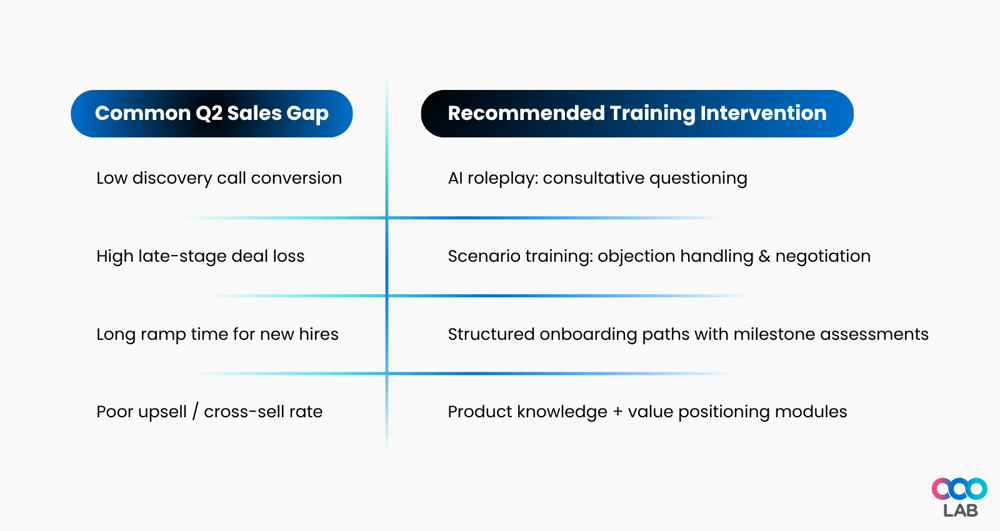
Late-stage losses typically signal negotiation or business case weaknesses. Poor discovery conversion points to consultative questioning gaps. Long ramp times often reflect onboarding that covers product knowledge but skips selling skills.
Read more
>>> Effective Sales Training Strategies for Boosting Performance
>>> Mastering Sales Training: Strategies for High-Performing Teams
Book a Free Demo with us. Bring your Training and Learning to a new height with LearningOS.
Once you know where the gaps are, the fix isn't more content, it's the right content assigned to the right role at the right time. A role-based sales training plan does exactly that. A mid-market AE and a new SDR don't share the same needs: training with real-world scenarios improves retention by 70% (Source: Sales Performance International), and role-specific programs see 20% higher win rates than uniform content (Source: Salesforce, 2024).

An AE who consistently loses at the business case stage needs negotiation and value-framing modules, not a product refresh. A new hire struggling to book discovery calls needs consultative questioning practice. Structured role-based paths also give managers a shared reference point, so coaching targets performance instead of repeating basics.
Read more
>>> Enterprise LMS for Sales Training: Driving Results with Role-Based Learning
>>> Sales Training Trends to Watch in 2026
AI coaching closes the gap between training sessions and live selling moments, giving reps real-time, scenario-specific feedback without a manager in the room. AI-guided coaching lifts win rates by 36% and deal-size growth by 35% (Source: Highspot, 2025). Skill Quotient OS, OOOLAB's AI roleplay and assessment tool, lets reps rehearse real selling scenarios with scored, competency-mapped feedback that transfers directly to live deals.
Training ROI lives in pipeline outcomes, not completion rates. LearningOS clients report $3.5 ROI on every dollar invested, with returns emerging within 6–12 months (Source: LearningOS client outcomes). After your reset, track win-rate shifts by deal stage, discovery-to-demo conversion, and new-hire ramp time against your H1 baseline, then connect that data to your CRM pipeline so the training-to-performance link is provable.
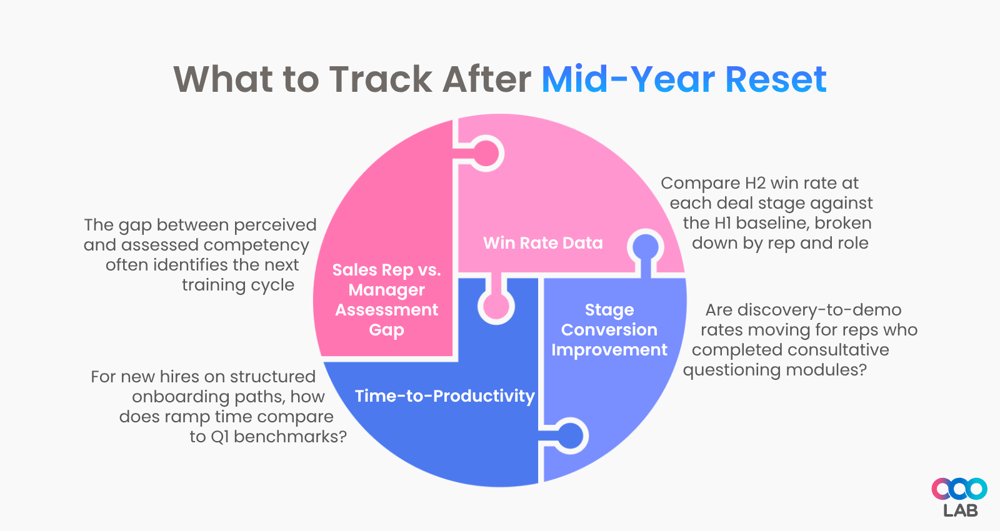
What to track after your mid-year reset:
Win rate delta: Compare H2 win rate at each deal stage against the H1 baseline, broken down by rep and role
Stage conversion improvement: Are discovery-to-demo rates moving for reps who completed consultative questioning modules?
Time-to-productivity: For new hires on structured onboarding paths, how does ramp time compare to Q1 benchmarks?
Rep vs. manager assessment gap: The gap between perceived and assessed competency often identifies the next training cycle
Connect your LMS analytics dashboard to your CRM pipeline. When learning activity maps to pipeline movement, the training budget conversation becomes straightforward. Your Q3 pipeline review becomes the proof.
Read more
>>> How to Measure ROI on Sales Training and Enablement Efforts
A professional development LMS with role-based pathways, AI coaching, and real-time analytics turns a one-time reset into a permanent operating rhythm. LearningOS supports over 250,000 learners across 23 countries, holds SOC 2 Type 2 and ISO 27001:2022 certification, and cuts training time by 40–60%.
H1 results don't have to define the rest of the year. Audit your skill gaps now, assign role-specific training, and layer in AI coaching, and Q3 can still close as a different team than the one that opened it.
Ready to see AI roleplay and assessment in action? Book a free Skill Quotient OS demo and watch your team's training performance shift.
At OOOLAB (pronounced "uːlæb"), our mission is to make complex learning operations simple. We aim to positively impact the lives of over 1,000,000 learners and educators by the end of 2026. OOOLAB's LearningOS provides educational institutions and corporate enterprises with an all-in-one solution to create and deliver engaging learning experiences.
Dedicated success manager
Personalized setup
Ongoing assistance
Learn more at thelearningos.com
What is a mid-year sales training reset?
A mid-year sales training reset is a structured process where sales leaders audit H1 performance data, identify specific skill gaps at the rep and team level, and deploy targeted training interventions before Q3 pipeline pressure peaks. Unlike ad hoc coaching, it's driven by data - win rates, deal velocity, objection patterns - and measured against a clear outcome: improved Q3 performance.
How do you identify skill gaps in a sales team?
The most reliable method is to cross-reference pipeline data with rep-level performance. Pull win rates by deal stage, discovery-to-demo conversion rates, and objection loss patterns from call recordings. Map each gap to a skill category - consultative questioning, negotiation, value framing - rather than defaulting to generic content. A competency-based enterprise LMS can automate much of this mapping and surface gaps at scale.
How does AI improve sales training outcomes?
AI sales coaching delivers personalised, scenario-based practice in real time - without requiring a manager to be present. Reps rehearse objection handling, discovery, and negotiation in simulated environments with scored feedback after each session. According to Highspot's State of Sales Enablement Report 2025, B2B companies using AI coaching are 20% more likely to improve revenue outcomes, and AI-guided coaching improves win rates by 36%.
What should a Q3 sales training plan include?
A strong Q3 plan starts with a gap audit from H1 data, followed by role-specific learning paths tied to those gaps. It should include AI-powered roleplay for skill practice, manager coaching focused on deal strategy rather than basics, and analytics that connect training completion to pipeline metrics. Deploying in June gives approximately 60 days to embed new behaviours before Q3 deals close.
How long does it take to see results from sales training?
Results vary by training depth and measurement approach. LearningOS clients typically see positive ROI within 6–12 months of implementation, including $3.5 return on every dollar invested. For a mid-year reset specifically, measurable shifts in win rate and deal velocity are often visible within 60–90 days - when training is tied to real gap data and includes AI-powered practice rather than content consumption alone.