A rep finishes a call convinced it deserves an 8. The manager listens to the recording later and gives it a 5. With no evidence on the table, the argument over the rep's skill quotient gets settled by seniority.
Both scores feel fair. Neither is a measurement. Here is why they differ, and what to score instead.
Only partly. Research on salespeople finds that self-ratings and manager ratings agree only weakly (Jaramillo, Carrillat and Locander). Self-ratings still carry real signals about results, so they are useful input. Treat them as testimony, not evidence. The rep isn't lying. The rep is remembering.
The weak agreement is not a sales quirk. A meta-analysis of more than 37,000 employees found the same thing across jobs: what people say about themselves and what supervisors say about them overlap far less than anyone assumes (Heidemeier and Moser).
The reason is simple. The rep and the manager are not looking at the same thing. Picture the Monday review. The rep remembers the objection they handled well. The manager remembers the pricing question that got a shrug. Both memories are fair. Neither is a recording.
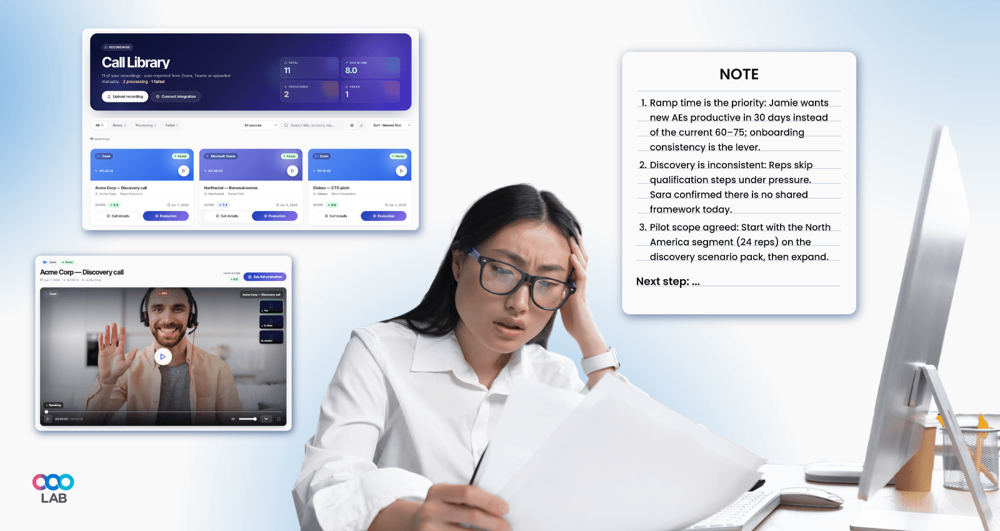
Self-ratings skew in both directions. In a study of salespeople, bottom performers overestimated their results, top performers underestimated theirs, and the weaker group was also the less accurate one (Jaramillo, Carrillat and Locander). A self-rated skill quotient therefore tends to flatter the weakest reps and shortchange the strongest.
The extreme cases are easy to spot. In a Zenger Folkman dataset of individual contributors, roughly 1 in 25 ranked themselves in the top quartile while their manager ranked them in the bottom quartile (Zenger Folkman). The sample spans roles rather than sales alone, but the direction of the gap matches. Across Western samples, self-ratings also ran higher than supervisor ratings on average (Heidemeier and Moser).
Confidence is a feeling. A skill quotient needs a measurement.
Read more
>>> How To Measure Skill Quotient In Employees?
>>> Why Skill Gaps in Sales Training Surface as Lost Deals
>>> IQ, EQ, and now, SQ: Why Skill Quotient Is the Defining Metric for Today's Workforce
See LearningOS in action: schedule your free demo and find out how your team can train smarter, not harder.
A skill quotient (SQ) is a measurable score of how well someone performs a specific skill, based on evidence of what they actually do. In sales, that evidence is the call. (This is the workplace SQ, not the social or spiritual one.)
A trustworthy skill quotient compares three things: what the rep says happened, what the manager thinks happened, and what the call shows happened. Only the third can settle an argument.
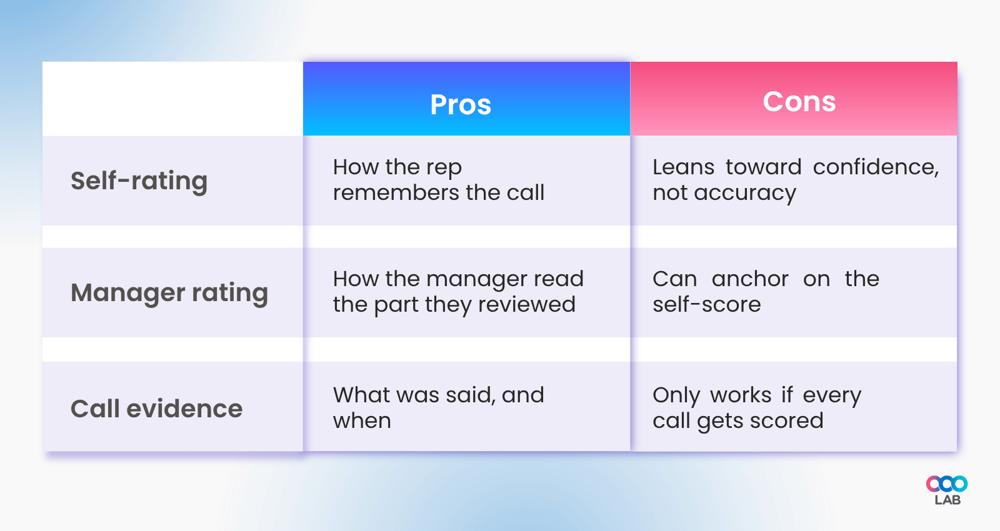
Managers are not a clean benchmark either. In research co-authored by Harvard's Iris Bohnet at a multinational, manager ratings tracked employee self-ratings closely when managers read them first (Harvard Gazette). In the one year managers could not see them, the link weakened. A skill quotient built on both is still mostly opinion.
Researchers split on which rating is more accurate. A 2004 comment challenged the finding that self-reports are less accurate than manager ratings (Sharma, Rich and Levy). The defensible summary is narrower: the two barely agree, and neither is evidence.
Self-reports are not worthless, either. They tracked objective results, though less closely than manager ratings did (Jaramillo, Carrillat and Locander). The kind of indicator also mattered: nonjudgmental performance indicators were among the main factors shaping how closely the two ratings agreed (Heidemeier and Moser). Asking for facts instead of feelings is the first step toward call evidence. Either way, a skill quotient needs something firmer than either rating.
Effective sales training scores the call, not the memory of it. Skills Quotient AI grades every customer call against your own sales playbook, down to the exact moment that mattered. Each skill gets a score out of ten and a target, so the rep and the manager look at the same number.
Self-ratings can also skew the training itself. A rep who underrates a strong skill may be coached on it anyway. One who overrates a weak skill may be waved through. Three changes are worth starting with:
Score the call before anyone shares an opinion
Ask fact-based questions instead of "how did it go?"
Track one skill quotient score per skill, not one verdict per rep
For sales managers and enablement teams tired of settling call debates by seniority, the fix is a score that comes from the call itself.
A capability LMS tracks skills rather than course completions. Completions show who sat through the training. Skills show who can sell. In Skills Quotient AI, real calls, roleplays and courses feed one view, so a skill quotient reflects what the rep did, not what they remembered.
When a rep and a manager still disagree, Ask SQ settles it with the same call that produced the score. It lives inside every scored call record. Ask "Where did I slip?" and the answer comes back with timestamps for the exact moments. Averaging two opinions is a poor substitute for the recording.
Read more
>>> Skill Quotient Assessment Tools: Unlocking Employee Potential
>>> Data-Driven Training: Transforming Skill Quotient Development with Analytics
Reps and managers grade the same call differently because one is grading memory and the other is grading a sample of it. Give both the same recording and the argument becomes a coaching conversation. A skill quotient built on evidence gives the rep a target and the manager a reason to stop guessing.
Ready to see AI roleplay and assessment in action? Book a free Skill Quotient OS demo and watch your team's training performance shift.
At OOOLAB (pronounced "uːlæb"), our mission is to make complex learning operations simple. We aim to positively impact the lives of over 1,000,000 learners and educators by the end of 2026. OOOLAB's LearningOS provides educational institutions and corporate enterprises with an all-in-one solution to create and deliver engaging learning experiences.
Dedicated success manager
Personalized setup
Ongoing assistance
Learn more at thelearningos.com
1. What is a skill quotient in sales?
A skill quotient (SQ) is a measurable score of how well someone performs a specific skill, based on evidence of what they actually do. In sales, it is built from calls, roleplays and courses rather than self-ratings. Skills Quotient AI gives each skill a score out of ten and a target.
2. Can reps accurately rate their own sales calls?
Only partly. A meta-analysis found that salesperson self-ratings and manager ratings agree only weakly (Jaramillo, Carrillat and Locander). Self-ratings do track objective results, so they are useful input, but they are not a measurement.
3. Why do managers and reps grade the same call differently?
They work from different evidence: the rep from memory, the manager from whatever portion they reviewed. Managers can also anchor on the self-score. At one multinational, manager ratings tracked employee self-ratings closely when managers saw them first (Harvard Gazette).
4. Are self-assessments reliable for finding skill gaps?
Not on their own. Across more than 37,000 employees, self-ratings and supervisor ratings agreed only modestly (Heidemeier and Moser). Pair them with call evidence and a score per skill, and ask fact-based questions instead of opinion-based ones.
5. How do you measure skill quotient in sales without relying on opinions?
Score every call against your own sales playbook and track a score out of ten for each skill. Skills Quotient AI does this for every customer call, then feeds calls, roleplays and courses into one view. Self-ratings and manager ratings then become context, not the measurement.