
The invite lands at 9:50 and the call starts at 10:00, which leaves the rep ten minutes to open the CRM, skim the last note and hope for a friendly customer. Sales training covers the pitch, the discovery and the close, but the ten minutes before the call gets none of it.
For sales managers, L&D leaders and enablement teams tired of coaching a call after it goes sideways, the fix sits upstream. Call prep is trainable, and it never made the syllabus.
Call prep is the work a rep does before a customer call: reviewing the account, planning the opening and lining up answers to likely pushback. Sales training skips it because prep gets treated as a personal habit rather than a skill, so every rep builds a private version and no manager can see which one works.
Check any onboarding calendar: week one is product, week two is the pitch, week three is discovery, and nobody books a session called "Getting ready." Reps improvise as a result, with one rereading the last email thread, another scrolling LinkedIn and a third calling it instinct. That leaves sales training grading the performance while ignoring the rehearsal.
Prep isn't a personality trait, it's a process nobody wrote down.
Buyers arrive informed, and in a Gartner survey of 645 B2B buyers, 69% said they turn to sales reps to validate what AI told them (Gartner). Validation takes preparation, and a rep who hasn't read the account can't confirm anything.
An unprepared rep sounds the same in every industry: a generic opener, no sense of what changed at the account and a first objection that lands cold with no answer ready. That last one costs the most: the customer says the hard thing once, and the rep answers it live for the first time.
Prepared reps ask better questions, while unprepared reps ask the ones the CRM already answers, and customers hear the difference within the first minute. Sales training rarely shows reps what that difference sounds like.
Every objection gets a first time, and it shouldn't be the real one.
Read more
>>> How Role-Playing in Sales Training Benefits Sales Enablement Goals
>>> AI Sales Roleplay: The Missing Link Between Training Investment and Revenue Results
Not sure where to start? Book a free session with our team and we'll map out a solution built around your training goals.
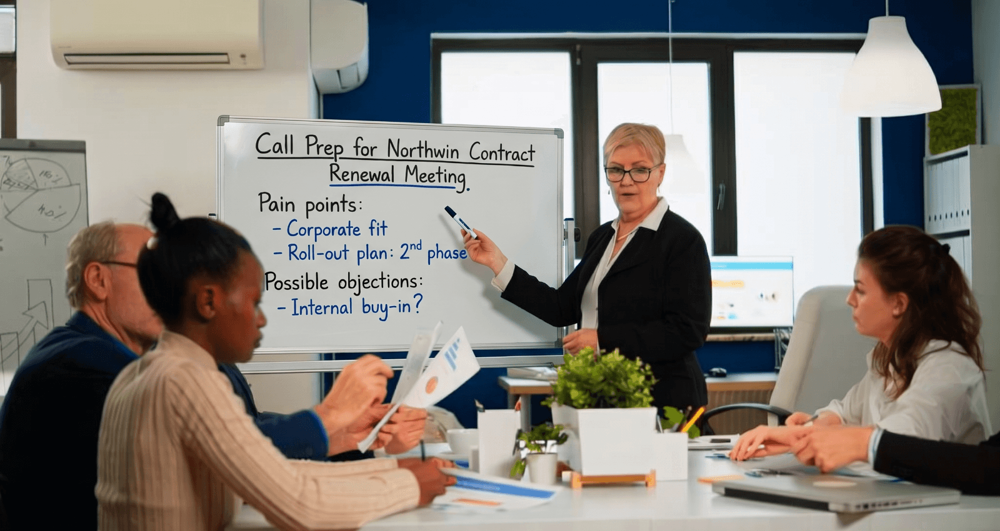
Call prep is still done by hand because the information lives in too many places: CRM notes, email threads, past recordings and the playbook sit in separate tabs, and the rep stitches them together before the call. That's assembly work, not preparation, and sales training that ignores it leaves every rep rebuilding the brief from scratch.
Reps have little time, since Salesforce's 2026 State of Sales report puts selling at 40% of the average workweek (Salesforce). Gartner found half of B2B sellers overwhelmed by the technology their job requires, and those sellers were 45% less likely to attain quota (Gartner).
Another tab is not a prep strategy.
Effective sales training treats call prep as four checkable skills: knowing the customer, opening the call, answering the pushback and rehearsing the exact conversation. Teach those four and prep stops being a habit.
A usable call brief holds four things:
Context: who the customer is and what changed
Opening: how to start the conversation
Objections: likely pushback, paired with the line that answers it
Rehearsal: the real call, run once before the dial
Build the brief from your own playbook rather than from a framework that's "best practice" somewhere else, because a generic brief produces generic calls. Sales training for managers matters here too, since a manager who can read a brief can coach in minutes before the call instead of replaying the recording after it.
A brief is a lesson plan for one call.
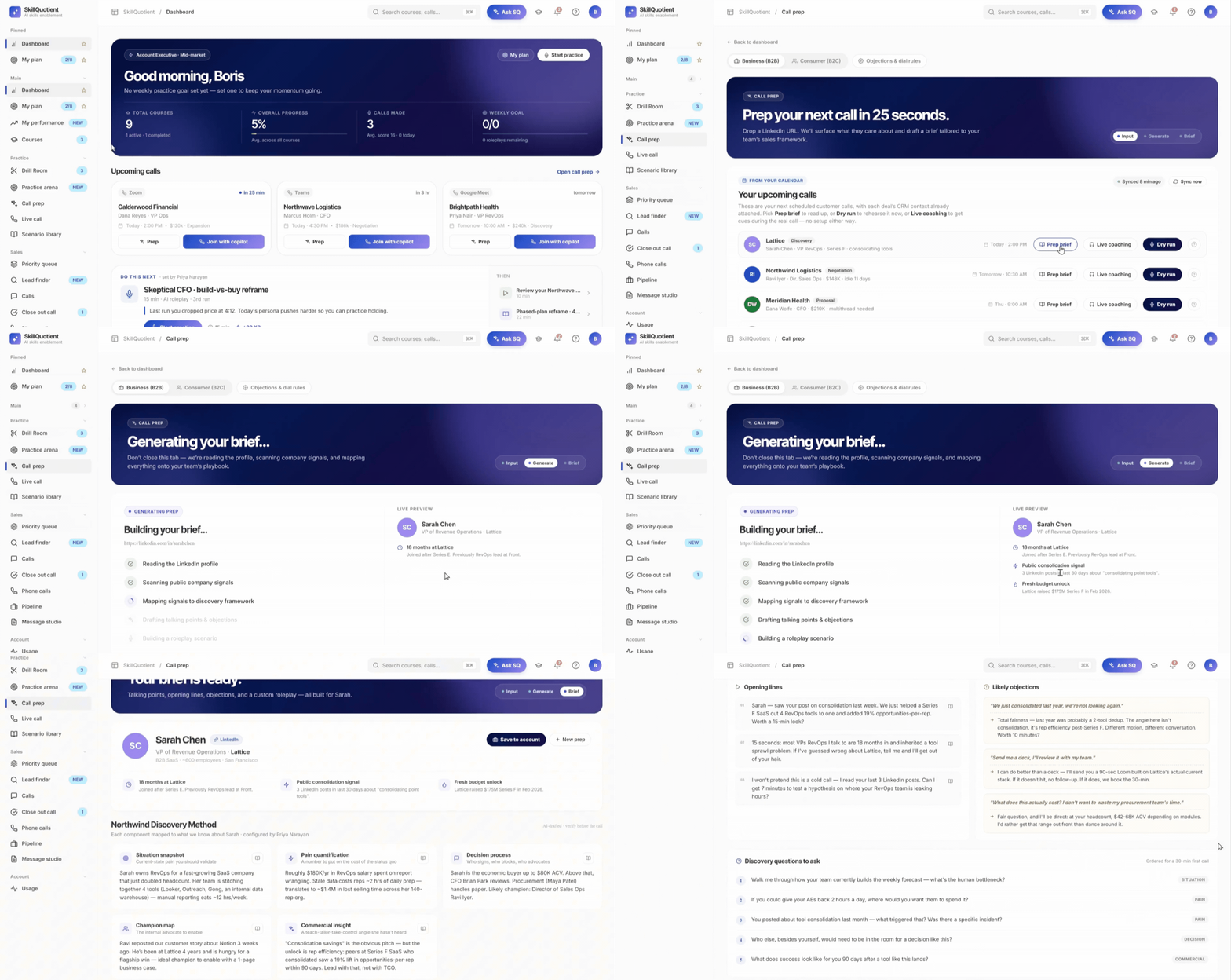
A brief tells the rep what's coming, and a rehearsal lets them hear it. AI sales roleplay closes that gap by running the exact call, with the same customer and the same objections, before the rep dials.
That's the logic behind Skills Quotient AI, OOOLAB's AI roleplay and assessment product. A customer call lands on the calendar and syncs with the CRM, and one click builds a call brief from your team's own playbook. Then the rep rehearses it.
The hardest question of the day still gets asked, but this time the roleplay asks it and the rep gets a second try. That is where sales training stops being a classroom event and joins the calendar.
Read more
>>> Building a Sales Enablement Playbook to Enhance Training Effectiveness
>>> Why Skill Gaps in Sales Training Surface as Lost Deals
>>> Sales Training in the AI Era: Building the Skills Reps Actually Need
Sales training earns its budget when the effect shows up in calls, so measure call prep there. Start with three metrics:
Share of customer calls with a brief built
Objections predicted versus objections heard
Skill scores on the same objections, call over call
Skills Quotient AI gives each skill a Skill Quotient score out of ten and a target, so "handles pricing pushback" stops being an opinion.
If prep can't be measured, it stays a habit.
Sales training has a blind spot in the ten minutes before the call: buyers notice it, managers inherit it and reps pay for it live. Better sales training doesn't need a new methodology, only a brief built on your own playbook, a rehearsal with the same objections and a score you can track.
Coach the prep, and the call has less to rescue.
Ready to see AI roleplay and assessment in action? Book a free Skill Quotient AI demo and watch your team's training performance shift.
At OOOLAB (pronounced "u:laeb"), our mission is to make complex learning operations simple. We aim to positively impact the lives of over 1,000,000 learners and educators by the end of 2026. OOOLAB's LearningOS provides educational institutions and corporate enterprises with an all-in-one solution to create and deliver engaging learning experiences.
Dedicated success manager
Personalized setup
Ongoing assistance
Learn more at thelearningos.com
1. What is call prep in sales?
Call prep is the work a sales rep does before a customer call: reviewing the account, planning the opening, anticipating objections and lining up answers. Done well, it turns the first minutes of the call into a conversation instead of a catch-up.
2. How long should a rep spend preparing for a sales call?
A rep should spend as long as it takes to cover four things: customer context, the opening, likely objections with answers, and one rehearsal. No fixed number of minutes fits every call. A brief that builds itself from the CRM and the playbook shortens the assembly time without cutting the thinking.
3. What should a sales call brief include?
A sales call brief should cover who the customer is and what has changed, how to open the conversation, the likely objections paired with the line that answers each, and a rehearsal of the exact call. Anything beyond that tends to go unread.
4. How do you train reps to handle objections before the call?
Train reps to handle objections by rehearsing them. An AI sales roleplay can run the exact call with the objections the customer is likely to raise, so the rep hears the hard question and answers it once before the real conversation. Managers can then review how the rep handled it.
5. How do you measure whether call prep is working?
Measure call prep with three numbers: the share of customer calls with a brief built, objections predicted versus objections actually heard, and skill scores on the same objections over time. Rising scores and fewer cold objections show the prep is landing.