Sales orgs have adopted AI faster than they've updated how they train for it. Nearly half of GTM leaders name building an effective training programme as one of their top challenges today (Source: Highspot State of Sales Enablement Report, 2025).
Sales training hasn't caught up to how fast AI has entered the sales process. Reps are working alongside AI agents daily, but most training curricula still teach the job as it looked three years ago. This article looks at what sales training actually needs to cover now, and why the gap matters more than the technology itself.
AI agents now handle prospecting, lead scoring, and CRM enrichment before a rep ever picks up the phone. That shift changes what a rep spends their day doing, but it doesn't remove the rep from the process. It moves them further up the decision chain, closer to judgment calls and further from repetitive research work.
The mechanics of the job are shrinking. The decisions attached to it are getting heavier. That's the part most sales training programmes haven't caught up to yet.
Traditional sales training doesn't cover this gap because it was built to teach outreach mechanics, not judgment calls on AI-flagged leads. Most programmes still assume every rep starts from a blank slate, an assumption AI adoption has made outdated.
That gap shows up clearly in how most curricula are still structured. They teach how to write a cold email, run a discovery call, and handle objections, skills that still matter, but skills that say nothing about reviewing what an AI agent already did. Closing that gap is exactly the challenge nearly half of GTM leaders point to when asked about training programme design (Source: Highspot State of Sales Enablement Report, 2025).
Built for L&D leaders who need results, not more admin. Book your free demo and bring your learning operations up to speed.
Read more
>>> Sales Training Trends to Watch in 2026
>>> Effective Sales Training Strategies for Boosting Performance
AI-era sales training pairs traditional skills with a new one: reviewing what an AI agent already did. In practice, that means reps rehearsing lead-review decisions, not just outreach scripts, before those decisions carry real revenue.
Reps who work alongside AI tools book 23% more meetings than reps who don't (Source: HubSpot State of Sales Report, 2024). That gain doesn't happen automatically. It happens when sales training teaches reps how to use the agent's output well, not just hand it off and hope.
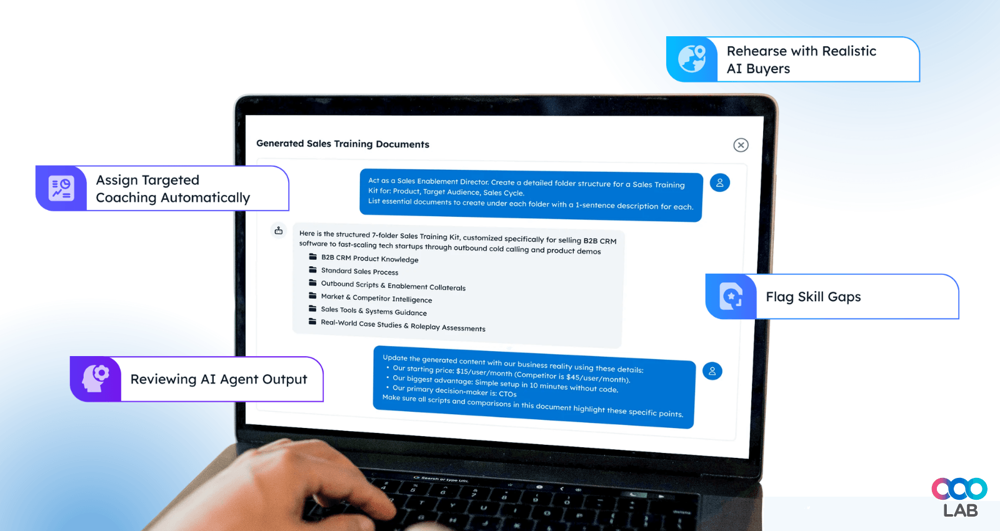
This is where Skills Quotient AI fits in. OOOLAB's AI-powered sales roleplay tool lets reps rehearse tough conversations against realistic AI buyer personas, then reviews their real customer calls to flag skill gaps and assign targeted coaching automatically. It also clears the admin work that used to eat into selling time, updating CRM records, moving pipeline stages, and drafting follow-up emails, so reps spend that saved time closing the skill gaps the practice loop just found. Reps build the judgment this shift demands through practice, not by guessing on a live deal.
When AI generates engagement reports automatically, SDR managers spend 30% less time on manual coaching and activity tracking (Source: Gartner Sales Technology Adoption Survey, Q3 2025). That freed-up time is only valuable if sales training redirects it toward something useful.
The skill worth teaching here is specific: checking an agent's reasoning, not just its conclusion. Did it flag a lead as hot for a legitimate reason, or did it miss context a human would have caught? A rep trained to ask that question catches errors before a prospect ever sees them.
Reps now split their time roughly 50/50: half on relationship-building, half overseeing AI agents (Source: Betts Recruiting, "The Future of GTM in the Age of AI," 2026). Sales training programmes need to reflect that split directly, not treat relationship skills and agent oversight as separate tracks.
An agent can qualify a lead, draft an email, and book a meeting. It can't read hesitation in a buyer's voice or adjust a pitch mid-conversation. Training that only covers the mechanical half of the job leaves reps unprepared for the half that actually closes deals.
Picture a deal that stalls for reasons the CRM can't explain: a stakeholder goes quiet, or a new decision-maker joins the call unannounced. No agent flags that as a risk. A rep trained to notice it is the difference between a deal that recovers and one that quietly dies.
Onboarding time drops by roughly 40% when AI handles list-building and outreach setup for new reps (Source: The Bridge Group SDR Metrics & Compensation Report, 2025). That's a real time saving, but it only becomes a sales training win if the freed-up ramp time goes into structured coaching instead of disappearing.
Sellers who work well alongside AI agents are also close to four times more likely to hit quota than those who don't (Source: Gartner, cited via SecondBody, 2026). That gap is a training outcome, not a tooling outcome. It's the clearest ROI case for investing in structured, AI-era sales training now.

A modern sales training programme should track:
Onboarding speed for new reps working alongside AI agents
Time reinvested into coaching versus administrative work
Quota attainment for AI-trained reps versus untrained reps
Lead-review accuracy: how often reps catch what the agent missed
Read more
>>> AI in Sales Training and Enablement: Transforming the Sales Landscape
>>> The Role of Technology in Sales Training and Sales Enablement
AI didn't remove the need for skilled sales reps, it raised the bar on what skilled means. The organisations pulling ahead aren't the ones with the most advanced agents. They're the ones whose sales training programmes caught up to the job reps actually do now: reviewing, judging, and stepping in exactly when it counts.
The best training platforms prove their value quickly. Explore LearningOS and find out why clients see a strong return well within their first year.
At OOOLAB (pronounced "uːlæb"), our mission is to make complex learning operations simple. We aim to positively impact the lives of over 1,000,000 learners and educators by the end of 2026. OOOLAB's LearningOS provides educational institutions and corporate enterprises with an all-in-one solution to create and deliver engaging learning experiences.
Dedicated success manager
Personalized setup
Ongoing assistance
Learn more at thelearningos.com
1. How should sales training programs change for AI tools?
Training needs to shift from pure outreach mechanics toward judgment skills: reviewing AI agent output, scoring which flagged leads are genuinely worth pursuing, and knowing when a conversation needs a human handoff.
2. What does an AI-era sales training curriculum include?
A modern curriculum pairs traditional skills like objection handling and discovery calls with new ones: reviewing agent reasoning, catching missed signals, and practicing scenario-based judgment calls through AI-powered roleplay.
3. Will AI SDRs replace sales reps?
No. The highest-performing sales teams run hybrid models where AI handles volume and consistency while reps handle nuance, judgment, and complex conversations. Structured training is what makes that hybrid model work.
4. How do I measure ROI on AI-era sales training?
Track onboarding speed, time reinvested into coaching versus admin, and quota attainment for reps trained to work alongside AI agents versus those who aren't. The gap between the two is the ROI case.
5. What skills should sales training prioritize when reps work alongside AI agents?
Prioritize reviewing agent output critically, scoring lead quality beyond what the agent flags, and relationship-building skills for the moments automation can't cover.