The deal is lost. The rep's notes say "went fine." The manager now has an afternoon, a 30-minute recording and a pause button.
Hunting for the miss by rewatching is not effective sales training. It's archaeology. For sales managers and enablement teams who are tired of paying for hindsight in an afternoon, there's a faster way to find what went wrong. This article explores why rewatching fails and what a structured call review looks like, supported by data-driven insights.
A sales call review process is a repeatable method for turning a recorded call into specific coaching. It finds where the call turned, quotes what the rep said and offers a better line. Rewatching is not that process. Rewatching is a hunt with a pause button.
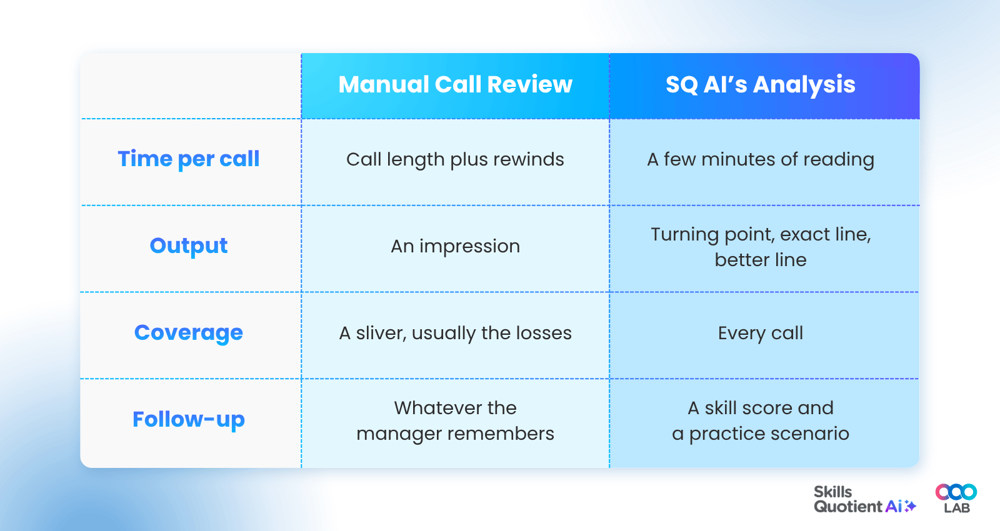
Picture the usual version. Play. Pause. Rewind. Skip ahead, miss the moment, go back. One 30-minute call can swallow an afternoon, and the write-up comes from memory. The notes said "went fine." The recording disagreed.
Managers don't skip this because they don't care. They skip it because it doesn't fit. 73% of sales managers spend under 5% of their time coaching (Sales Management Association via Training Industry). An afternoon-sized process loses to the pipeline meeting every time.
The real cost isn't the hours. It's a hunch, delivered a week late.
Because the sample is too small and too biased to show a pattern. Sales-tech vendors estimate that managers review only 1 to 2% of recorded calls (Aircall), and the ones picked are usually the ones that already failed. That's an autopsy, not sales training.
Most reviews start with the loss. Few start with the near-misses that looked fine, where the same habit was hiding. A library of recordings nobody opens is storage, not coaching.

Effective sales training needs a review that costs minutes and covers every call, not just the loud ones. Coverage, not heroics.
Read more
>>> Why Skill Gaps in Sales Training Surface as Lost Deals
>>> Leveraging Sales Enablement Analytics to Refine Training Strategies
See LearningOS in action: schedule your free demo and find out how your team can train smarter, not harder.
A structured call review returns three lines per call: the turning point, the exact line the rep said, and a better line. No scrubbing. No guessing. The manager reads the breakdown in minutes and spends the saved hours on the coaching conversation.
Call it the three-line breakdown:
The turning point: where the call moved against you
The exact line: what the rep actually said, word for word
The better line: what to say instead
Picture it in use. A rep answers a budget objection by listing features. The breakdown flags the line, timestamps it and offers a better one: ask what the budget is being measured against. The rep reads it in two minutes and knows what to change.
Feedback with a timestamp gets used. Feedback without one gets nodded at.
Call review becomes sales training when every real call, roleplay and course feeds one view. Each skill gets a score out of ten and a target to chase. Review stops being a verdict and becomes a direction. The loop closes when the next call shows whether practice worked.
The loop runs in four steps:
Read the three-line breakdown for each call.
Check the skill score against its target.
Turn the missed moment into an AI Sales Roleplay scenario.
Check the next real call for the fix.
That's the idea behind Skills Quotient AI, part of OOOLAB's LearningOS. Real calls, roleplay sessions and course results land in one record, so a rep's score shows where they sit against the target. The missed objection from Tuesday's call becomes Wednesday's practice scenario.
Timing matters. Sales reps typically forget 70% of what they learn in training within a week (Gartner via Articulate). A week is not long. Practice the exact moment that cost the deal while the call is still fresh.
Same data, three sources, one number. Reps know where they stand. Managers know where to look.
Read more
>>> Mid-Year Sales Training Reset: A Playbook for Q3 Performance
>>> Sales Training in the AI Era: Building the Skills Reps Actually Need
>>> Building Sales Proficiency: Elevate Your Team's Skill Quotient
Yes. Software handles the observation: finding the moment, quoting the line and scoring the skill. The manager still picks the priority, reads the context and has the conversation. Automation removes the scrubbing, not the coaching.
Forrester found that 65% of high-impact sales organisations report managers spending 20% or more of their time coaching (Forrester). Twenty per cent is possible when a review takes minutes. When it takes an afternoon, it's a slogan.
Reps benefit too. A breakdown they can read, replay and practise against beats a verbal recap nobody remembers by Friday. Let the system watch the call. Let the manager coach it.
Rewatching recordings feels like diligence. It's closer to overtime nobody asked for. A structured review gives you the turning point, the line and the fix, plus a score that moves as reps practise. Your sales training stops guessing and starts pointing at the exact moment that needs work. Memory is a poor witness. The call isn't.
Ready to see AI roleplay and assessment in action? Book a free Skill Quotient OS demo and watch your team's training performance shift.
At OOOLAB (pronounced "uːlæb"), our mission is to make complex learning operations simple. We aim to positively impact the lives of over 1,000,000 learners and educators by the end of 2026. OOOLAB's LearningOS provides educational institutions and corporate enterprises with an all-in-one solution to create and deliver engaging learning experiences.
Dedicated success manager
Personalized setup
Ongoing assistance
Learn more at thelearningos.com
1. What is a sales call review process?
It's a repeatable method that turns a recorded call into specific coaching. A structured version flags the turning point, quotes the exact line and suggests a better one, then scores the skill involved. It replaces open-ended rewatching with the same clear output every time.
2. How long should a lost-deal post-mortem take?
Minutes, not an afternoon. If a manager has to rewatch a 30-minute call to find the miss, the process is the problem. A breakdown that flags the turning point and the exact line lets the manager read it quickly and spend the remaining time on the coaching conversation.
3. How many sales calls should a manager review?
Sales-tech vendors estimate that managers review only 1 to 2% of recorded calls. That sample is too thin to show patterns. The goal is coverage of every call, with manager time reserved for the calls that need a conversation.
4. How is call review different from sales coaching and sales training?
Call review finds what happened on a call. Sales coaching is the conversation that changes it. Sales training is the practice that makes the change stick. A structured review feeds both, because the breakdown becomes the coaching agenda and the practice scenario.
5. Can AI replace manager call review?
No. AI can handle the observation: finding the turning point, quoting the line and scoring the skill. The manager still chooses the priority, judges the context and has the coaching conversation. It removes the scrubbing, not the coaching.